Return to overview

New ways for tram infrastructure: How “New Urban Track” advances urban track construction
28 October 2026 | 

Increasing rail wear, complex maintenance procedures, and growing demands for noise reduction and operational availability are characteristic challenges in the operation of tram and light rail systems. With "New Urban Track," voestalpine Railway Systems has created a newly developed track superstructure system for embedded track – tailored specifically to the requirements of modern tram networks.

More than just a rail: The system behind it

At first glance, a tram track may seem rather unremarkable. Yet wherever trams negotiate tight curves day after day, enormous forces act on the rails, fastening systems and the underlying infrastructure. The result is wear, noise and costly maintenance work. With “New Urban Track”, voestalpine Railway Systems has therefore taken a completely new approach. The entire system has been consistently designed around the requirements of urban mobility. 

Stefan Ziegerhofer –  Product Management, voestalpine Rail Technology

We really rethought every single component, from the rail to the fastening system. At the same time, the high degree of prefabrication allows installation work on site to be carried out much faster.

Stefan Ziegerhofer – Product Management, voestalpine Rail Technology

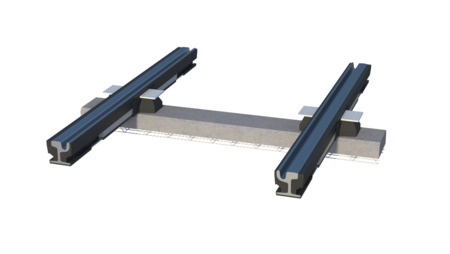
The new track system goes far beyond the further development of individual steel components. Instead, voestalpine Railway Systems relies on the interaction of different materials and technologies throughout the entire system.

Patrik Zefferer – Research & Development, voestalpine Railway Systems

When people think of voestalpine, they usually think only of steel. However, this system is not exclusively a steel construction. Plastic components are also used. In this case, the rail, which is embedded in concrete below the surface, is additionally enclosed by rubber elements.

Patrik Zefferer – Research & Development, voestalpine Railway Systems

These additional components perform important functions that contribute to the operation and service life of the system.

Harald Wimmer – Application Engineer, KRAIBURG STRAIL

The track damping system primarily has two major functions. The first is stray current insulation, which ensures the current return path of the rail vehicles. The second main purpose is vibration damping.

Harald Wimmer – Application Engineer, KRAIBURG STRAIL

Less wear, faster maintenance

One of the key development priorities of “New Urban Track” was optimizing the interaction between wheel and rail.

The goal is to reduce wear and increase the service life of the infrastructure. 

Roman Weilguny,  F&E Project Engineer, voestalpine Rail Technology

We have optimized the new rail profile to the point where we were able to reduce both wheel and rail wear by 30 percent. We initially achieved these results through calculations and simulations and will be able to validate them on the track in the future.

Roman Weilguny, F&E Project Engineer, voestalpine Rail Technology

However, a high-performance track system is not defined by the rail alone. Equally important is the way it is fastened within the track structure. 

Thomas Mayer – Vice President, R&D and Engineering Fastening Systems, voestalpine Railway Systems

One of the major challenges in tram fastening systems is the need for a compact design, as embedded track offers very limited installation space. The new fastening system provides a high degree of elasticity within the system, allowing significant elastic rail movement. Accessibility has been achieved through special access chambers and cover combinations, enabling maintenance work and rail release even when the system is fully covered.

Thomas Mayer – Vice President, R&D and Engineering Fastening Systems, voestalpine Railway Systems

This simplifies maintenance work and allows rails to be replaced more quickly.

Testing under real operating conditions

The decisive question, however, was how the new system would perform under real operating conditions.

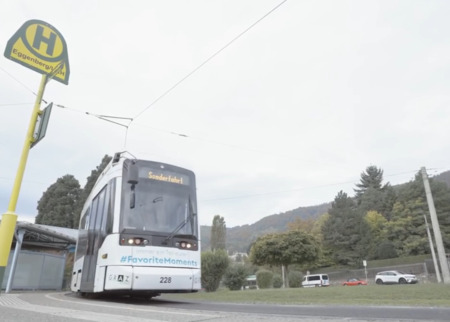
For this reason, the newly developed components were installed on test sections in Graz and Vienna and scientifically monitored.

Univ.-Prof. Dr. Ferdinand Pospischil, MSc – Head of the Institute of Railway Infrastructure Design, Graz University of Technology

When the new track structure was installed, we applied strain gauges. This allows us to measure the forces exerted by the tram on the track structure, compare them with our simulations, further improve the system and better understand how vehicle and track interact.

Univ.-Prof. Dr. Ferdinand Pospischil, MSc – Head of the Institute of Railway Infrastructure Design, Graz University of Technology

For operators such as Graz Linien, these tests provide significant added value. After all, alongside operational safety, the long-term economic viability of the infrastructure is becoming increasingly important. Close cooperation forms a vital foundation for this. 

Adolf Polivka – Head of Track Infrastructure & Track Construction, Holding Graz

voestalpine has been a partner of Graz Linien for 147 years. I believe both sides can be very proud of that.

Adolf Polivka – Head of Track Infrastructure & Track Construction, Holding Graz

Holistically designed for the cities of tomorrow

With its high degree of prefabrication, optimized rail profile and the ability to replace rails quickly, “New Urban Track” pursues a clear objective: making tram infrastructure more durable, cost-efficient and maintenance-friendly. The test field trials in Graz and Vienna provide valuable insights and lay the foundation for the further development of the system.