ultralights by voestalpine

High-strength steel for lightweight automotive design

Back to Overview

Tags:

Share:

2 minutes Reading time

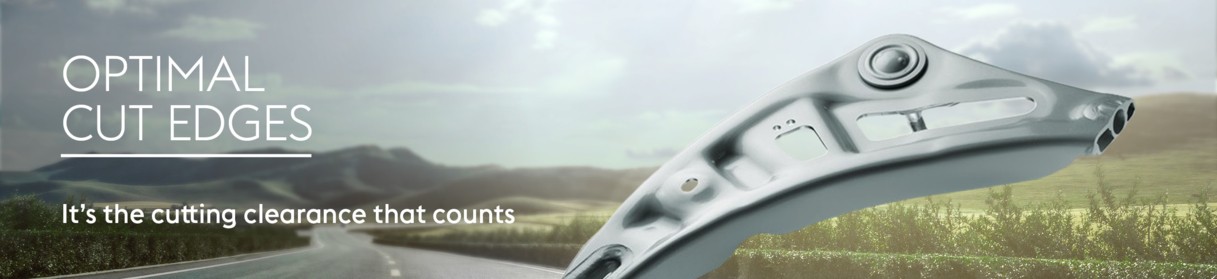
Header image on the topic of optimal cut edges: A chassis component against an abstracted road and sky background, with the text “Optimal Cut Edges—It's the cutting clearance that counts”.

High strength meets excellent formability

With its excellent formability combined with high strength, complex-phase steel HR660Y760T-CP is ideally suited for safety-critical structural and other high-strength vehicle components. A cutting clearance tailored to the material in the punching process is highly important to additionally increase the resistance of punched edges to edge cracking.

Developed for demanding forming processes 

The high-strength, hot-rolled multiphase steel is designed for complex applications where punched contours, extruded holes, and subsequent forming operations are standard. Not only do the properties of the material itself matter. The quality of the punched edge is equally critical, as damage introduced during punching has a significant impact on subsequent formability.

Hole expansion test as a measure of punched-edge formability

The hole expansion test according to ISO 16630 is used to evaluate the resistance of punched edges to cracking. This test indicates how well a material withstands local strains at the punched edge and how resistant it is to edge cracking. To determine hole expansion performance, a 10 mm diameter hole is punched into a test specimen which is then expanded using a conical punch tool until the first crack extends through the entire sheet thickness. The hole expansion ratio (HER) is determined from the difference between the expanded and original diameter, relative to the original diameter.

The optimal cutting clearance makes the difference
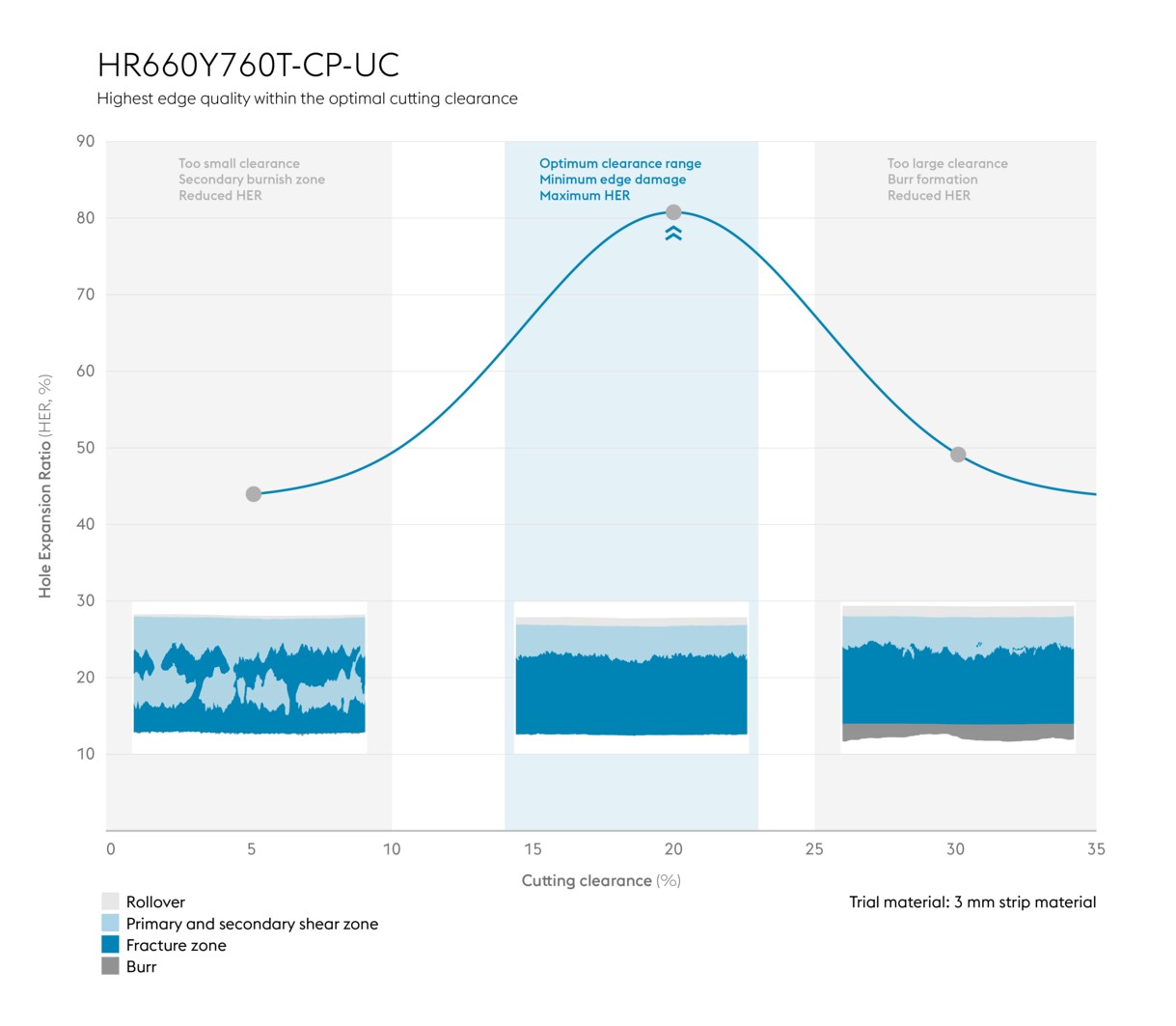
Tests by voestalpine have shown that both the material itself and the design of the punching process have a significant impact on subsequent forming performance. While the hole expansion test is typically performed using a cutting clearance of 12% of the sheet thickness, forming performance can be improved even further in practice by optimizing the cutting clearance. The following diagram illustrates the relationship between cutting clearance and hole expansion ratio for a series of test specimens cut from a 3 mm thick HR660Y760T-CP steel strip.

  • Very small cutting clearances of around 5% promote the formation of a secondary shear zone. The high local deformations and local punching defects, which introduce notches, increase pre-existing material defects and worsen edge formability.
  • Cutting clearances of around 25% or more result in burr formation at the punched edge. The burr also represents an area of reduced formability due to strain hardening, promoting premature crack initiation during forming. In addition, uneven burr formation can create a notch effect, further promoting crack initiation and reducing hole expansion performance.
  • At the optimal mid-range cutting clearance of around 20%, both secondary shear zones and burr formation are avoided, minimizing damage to the punched edge. In the test series, hole expansion performance therefore increased significantly within this range, reaching approximately 80%. Even within the range of the optimal cutting clearance, however, attention must be paid to optimal formation of the shear-affected zone (SAZ).

In summary, the results show that HR660Y760T-CP can fully exploit its high edge formability within a suitably selected cutting clearance range of around 20%. For automotive manufacturers, this means improved process reliability in production, a lower risk of edge cracking, and reliable manufacturing of highly stressed components.
Content you might also be interested in

12.03.2025

Automotive Dialogue 2025

Discover now

23.05.2023

Best of SLIMulations

Discover now

08.06.2026

Next-level quality assurance: new testing center fully operational

Discover now
Die Feuerverzinkungsanlagen am Standort Linz erstrahlen in neuem Glanz.

08.06.2026

Modernization of the hot-dip galvanizing lines

Discover now

08.06.2026

Car Body Parts 2026: Presentation of the Green Mission

Discover now

20.02.2026

10 years of ultralights made by voestalpine

Discover now

20.02.2026

MS1500: The new power class in cold forming

Discover now
voestalpine at EuroCarBody 2025

12.09.2025

voestalpine at EuroCarBody 2025

Discover now
2024 Customer Satisfaction Survey

11.09.2025

2024 Customer Satisfaction Survey

Discover now
Doris Haselsteiner from Product Management in the voestalpine Steel Division and Florian Gerstner from the Tec Center of voestalpine Automotive Components in an interview about the convincing advantages of galvanized door rings with phs-scalefree® steel.

11.09.2025

Galvanized door ring with phs-scalefree®

Discover now

13.08.2025

Strong partnership, strong future: voestalpine and Yanfeng

Discover now

22.05.2025

CRASH SIMULATOR 2.0 – Safety fit for the future

Discover now