News

News
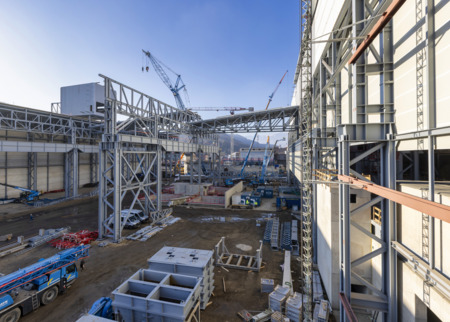
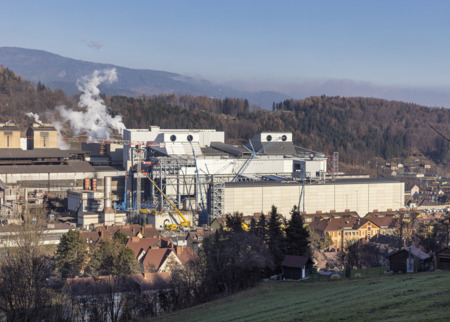
Danieli & C. Officine Meccaniche S.p.A., headquartered in Buttrio near Udine, is one of the world’s leading suppliers of plant engineering solutions for the metallurgical industry. As part of the transformation, over 10,000 tons of plant equipment from Danieli are being installed in Donawitz—a significant milestone for the project. Subsequently, Martin Hadler, Andreas Bobolik, and Michael Fasching from the Plant Projects/Plant Expansion department report on the current status of the work and provide exciting insights into the successful collaboration with Danieli.
Martin Hadler is the project manager for the heat recovery and dust removal system. He studied metallurgy at the Montanuniversität Leoben and has worked in Asia and Eastern Europe. He has been back in Leoben at voestalpine Stahl Donawitz GmbH for two years.
Mr. Hadler, what exactly is your area of responsibility?
Martin Hadler: My area of responsibility covers the subprojects of the EAF plant: dust removal and heat recovery. Since the project began in 2023, we have been working with Danieli as the plant manufacturer; in addition to the main EAF unit, they are also the supplier for the dust removal and heat recovery systems.
What is the day-to-day collaboration with Danieli like?
Hadler: I have been working closely with my colleagues at Danieli since the start of the project and coordinate the execution of these subprojects in close consultation, from planning and manufacturing through to delivery and installation.
Part of the Danieli team has been in Donawitz for several months now to handle the assembly of the components. The project language is almost exclusively English to avoid having to switch back and forth, even when using technical terms.
The components of the dust collection system are transported directly from the manufacturing facilities by truck to Donawitz, where parts of the units are already pre-assembled. The entire heat recovery system is shipped from Asia first by sea to northern Italy, from where it continues by truck to Donawitz. We inspected the components in advance at the respective manufacturing facilities before they were shipped. In total, we expect several hundred trucks for these two subprojects alone, some of which will be special transports carrying up to 90 tons.
Mr. Hadler, what does pre-assembly mean?
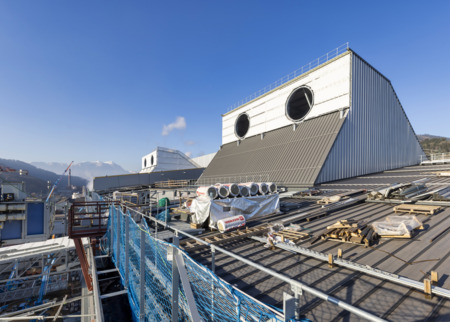
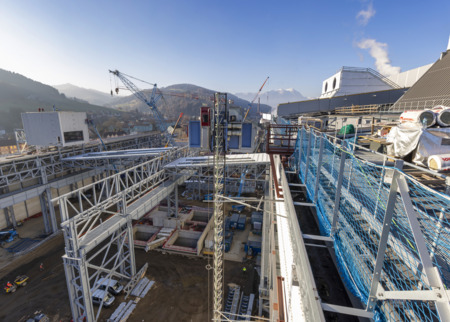
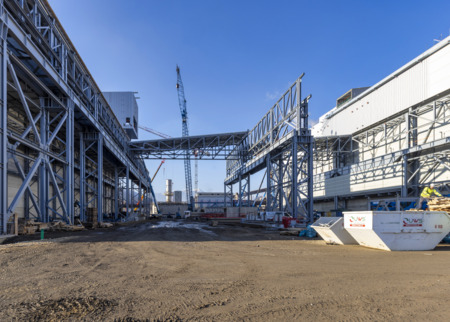
Hadler: Many of the components cannot be transported to Donawitz in one piece because they are either too bulky and/or too heavy. For this reason, a large portion of the components must be “pre-assembled” in Donawitz from the delivered individual parts. Certain sections of the halls are therefore still being constructed without a roof to allow the “heavy components” to be positioned.
Which parts are being delivered at the moment?
Hadler: The main exhaust duct for the EAFs, which is being delivered in individual parts from Turkey. The individual parts are prefabricated at the pre-assembly site and hoisted onto the construction site in 25-ton sections. These are then assembled above the furnace hall, run along the roof, and end in the filter building.
Currently, many components are still on their way to us, and many more are still being manufactured. It remains exciting, and we look forward to the next milestones.
Mr. Bobolik, what is special about “Crane 83”?
Bobolik: It is the most powerful crane ever installed in Donawitz. It has a span of 30 meters, is 14 meters wide, and six meters high. It has a total lifting capacity of 250 tons, which is roughly equivalent to the weight of 125 small cars.
“Crane 83” is a charging crane; it will be used in the furnace hall to lift the scrap basket, the pig iron ladle, and the EAF bottom vessel.
You inspected the crane and its components in Thailand—how is it now being transported to us here in Donawitz?
Bobolik: Exactly, the assembly took place at the Danieli plant near Bangkok. After acceptance, the parts were shipped. These are oversized heavy components; I think the term “oversized equipment” fits very well. First, they were shipped by sea from Thailand to Europe. From the port in Antwerp, Belgium, they travel via the Rhine-Main-Danube Canal to Linz, and from there by truck overnight to Donawitz. Now the parts are arriving at our site one by one. The challenge is that some roads have to be closed here, and at every step we have to keep in mind that a lot of space is required.
Mr. Fasching, what makes this work particularly exciting?
Fasching: These many individual parts arrive at our site over the course of several weeks and are then assembled and put into position in the days that follow. This requires a lot of know-how: what is arriving, how is it arriving, and are the resources available for assembly.
What is particularly important to you?
Fasching: Teamwork plays a major role. It’s an advantage for us that collaboration works well both internally and with our colleagues at Danieli. It’s also very important to plan well. In the case of the crane, there’s a pre-assembly phase, then parts are hoisted into place, and only after that does final assembly take place. Due to the heavy weight and the particularly large parts, we have to plan on a different scale here.