
Research and Development

Research and Development
Highly qualified staff and a state-of-the-art, accredited testing center are available to deal with the R&D issues, where mechanical-technological, metallographic and electron microscopic as well as dilatometer investigations can be carried out.
The focus of operational as well as strategic R&D work is to develop customer- and business-oriented solutions to complex issues. To this end, cooperation with university and non-university research institutions (e.g. Christian-Doppler-Gesellschaft, TU Graz, Montanuniversität Leoben, K1Met) but also competence centers at national level is forced. Approximately 20% of the total R&D budget is in the field of applied research.
As a long‑term goal, voestalpine intends to make its steel production entirely CO2‑neutral by 2050. In pursuit
of this goal, the Group is currently researching several new processes and investing in pilot projects intended to
uncover new paths in steel production. Hydrogen is set to play an important role.
We are already working closely with industrial and scientific partners to develop innovative technologies,
such as H2FUTURE (the world’s largest electrolysis system), Hyfor (Hydrogen‑based Fine Ore Reduction)
and SuSteel (Sustainable Steelmaking), in order to lay the technological groundwork for long‑term hydrogen‑based
steel production.
Discover our greentec steel research projects at the Donawitz site:
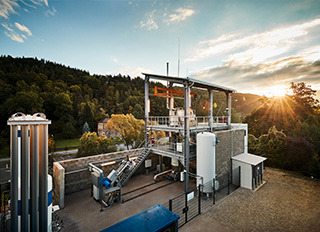
SuSteel (Sustainable Steelmaking) is a fundamental research project looking at the reduction of ores using
a new type of hydrogen plasma smelting reduction to produce a product that is similar to crude steel. It could
prove to be a means of reducing CO2 emissions. The test system for researching the technology is fully operational
and is being supported and operated in collaboration with project partners – voestalpine Stahl GmbH, the
University of Leoben and K1‑MET.
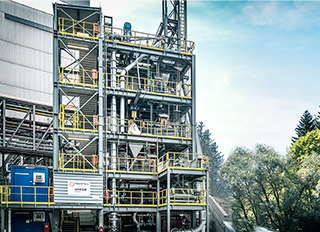
Hyfor (Hydrogen‑based Fine‑Ore Reduction) pilot plant from Primetals for the reduction of pellet feed with
hydrogen (hydrogen‑based direct reduction of iron ore) and production of hydrogen‑reduced DRI (direct
reduced iron) or HBI (hot briquetted iron). The plant was commissioned in August 2021. Research into the core
components required to upscale the system is currently being carried out in collaboration with voestalpine Stahl
Donawitz GmbH, the University of Leoben and K1‑MET.
Our goal is to create products that ensure optimum results in further processing. In order to meet the future needs of our customers as well as new market requirements, we are increasingly focusing on product and material development, which includes the following priorities:
In the large-scale technical sector, product and material developments are often associated with many hurdles: Too time-consuming and cost-intensive, too complex. In order to break new ground, it is necessary to be able to conduct research quickly and flexibly with very small quantities. At the same time, however, the results must also be optimally transferable to large-scale plants. We at voestalpine Stahl Donawitz have created an institution that enables research and development to be carried out in an innovative, flexible and application-oriented manner parallel to production - with the “Technikum Metallurgie (TechMet)” and the “Metallurgie Labor (MetLab)”. They are wordwide unique in their constellation and allow us to think and test outside the norm.
The department of research and development deals with the evaluation of raw materials and input materials as well as with the areas of product, process and customer-specific material development.