
Product Sustainability - Circular Economy

Product Sustainability - Circular Economy
The circular economy concept requires consideration of the overall value chain of products according to
ecological, economic and social aspects across all phases of the life cycle – from raw materials to production, use
or consumption to end of life, which itself represents the beginning of a new life cycle. Because of its durability and
the ease with which it can be repaired, plus the option of reprocessing it as scrap to form new products, steel is
considered a permanent material. Consequently, steel is already in a position to make an important contribution
to the EU’s goal of a circular economy by 2050.
At voestalpine Stahl Donawitz GmbH, this focus on the circular economy has long been implemented at process
and product level and undergoes constant further development.
The voestalpine focus when determining the sustainability of our products is currently on environmental aspects, i.e.
the analysis of the environmental impacts of products and their decarbonisation. A central element and
methodological tool for this is the life cycle assessment (LCA). This analysis requires uniform, resilient and globally
comparable methods that can contribute to creating an international level playing field and thus promote
sustainable economic growth.
The creation of an Environmental Product Declaration (EPD) is an important tool for determining and
communicating the environmental impacts of products based on a life cycle assessment. EPDs are based on the
EN 15804 and ISO 14025 standards and are checked and verified by independent third parties. EPDs for our
products – EPDs were created for continuously cast steel billets and hot‑rolled steel billets in 2023/2024 and
verified and approved by Institut für Bauen und Umwelt (IBU). They can be downloaded here:
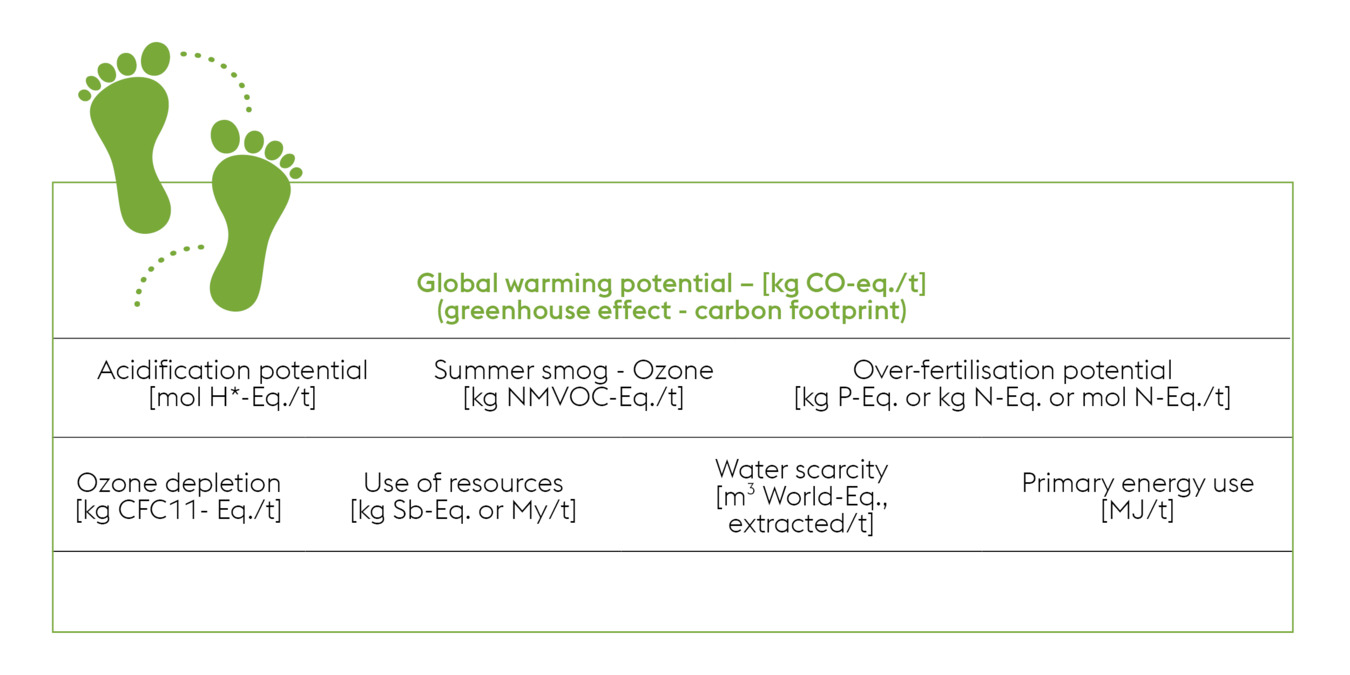
The EPD, which was prepared and externally verified in the 2023/2024 fiscal year, shows, among other things, the product carbon footprint in the form of the global warming potential for the raw materials.
Download it here:
| Product | kgCO2eq/t Product |
|---|---|
| Continuosly cast steel bloom |
2.510 |
| Hot-rolled steel billets |
2.640 |
The further development and expansion of the circular economy is an important pillar for reducing emissions and conserving resources. To this end, cycles should be closed, slowed down, or reduced. This can be achieved in the following ways, among others:
The use of recycled materials from our own steel production, as well as waste and secondary raw materials from external production processes, thus makes a significant contribution to the circular economy. By-products from steel production can in turn be used as secondary raw materials for the manufacture of products in other industrial sectors, such as the use of granulated blast furnace slag in the cement industry.
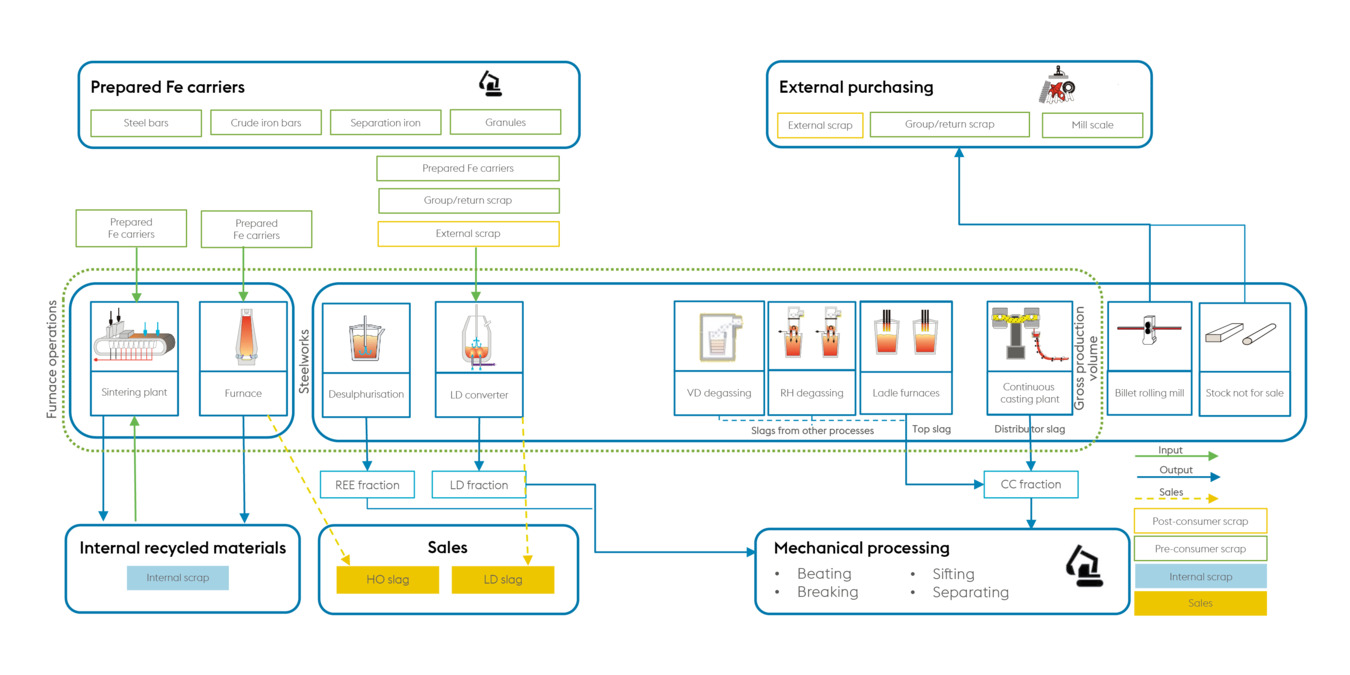
As a material, steel can be almost fully recycled, as all resulting products can be fully recycled as scrap at the end of
their service life, as many times as needed. Resource‑friendly production requires product service lives to be extended and the reusability and recyclability of products to be continuously improved. Own scrap and external scrap are thus an important raw material base, both for conventional technology (use in steelworks) and for the envisaged conversion to electric furnaces.
The recycling rate has been calculated in accordance with the definitions contained in ÖNORM EN ISO 14021 and
takes the post‑consumer and pre‑consumer portions used into account; the internal scrap portion was also included in the overall recycling rate.
| Recycling rate ÖNORM EN ISO 14021 |
25% |
|---|---|
| Post-consumer scrap | 9% |
| Pre-consumer scrap | 16% |
| Total recycling rate | 33% |
| Post-consumer scrap | 9% |
| Pre-consumer scrap | 16% |
| Internal scrap | 8% |
Granulated blast furnace slag is used as an aggregate in the cement industry, thereby improving the mechanical properties of cement and reducing CO2 emissions during cement production.
Blast furnace slag is a material with a complex chemical composition—a mixture of silicates, aluminates, and calcium oxide—which varies depending on the origin and composition of the raw materials. The addition of blast furnace slag makes cement more resistant to chemical attack and corrosive environments.
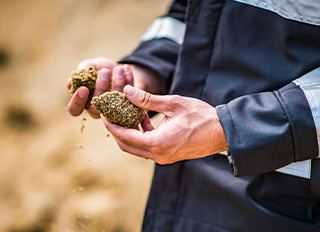
The components improve the strength and durability of cement and reduce the likelihood of cracks and spalling. In addition, granulated blast furnace slag makes a valuable contribution to reducing CO2 emissions in cement production. Sales volumes of granulated blast furnace slag have remained constant in recent years and consist of the amount produced on an ongoing basis and the reduction of historical stockpiles. These stockpiles were created at a time when the reuse of by-products did not yet play a significant role and efforts by other industries to keep their emissions low were not yet well advanced. Reducing these inventories involves considerable costs, but the efforts are worthwhile as an important contribution to Austria's ambitious climate targets.