
News

News
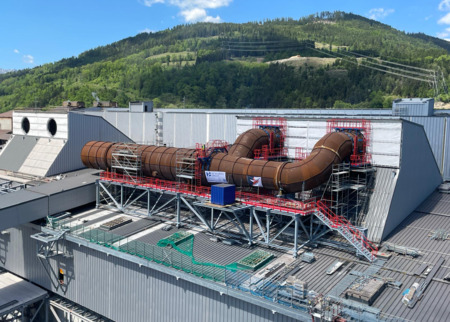
In early June, a significant milestone was reached in the project’s progress: The first section of the EAF unit’s exhaust ducts was successfully installed. The installation of these complex components represents a key step in the overall implementation, as the exhaust ducts are crucial for the safe and efficient operation of the unit. The second phase of the installation is already planned and is scheduled to take place in early July.
The path to a successful installation does not begin on the construction site, but much earlier—namely at the pre-assembly site. Here, the individual components are carefully prepared in advance. This step is essential to ensure that the actual hoisting process runs smoothly. The components are pre-assembled, inspected, and precisely measured so that they can later be seamlessly positioned in their intended locations.
Pre-assembly, in particular, presents special challenges for the teams involved. The primary focus is on ensuring that the manufactured parts fit exactly onto the existing substructure and the designated support surfaces. Equally crucial is the correct execution of the interfaces between the individual components. These must be prepared with precision to ensure error-free and safe installation.
The actual lift—that is, the hoisting and positioning of the pre-assembled parts—is carried out by specialized contractors. This is always done in close coordination with the project’s overarching schedule. Carrying out such a lift is by no means a spontaneous action: Behind every single lift lies a detailed lift plan.
This plan takes numerous factors into account. These include, among other things, selecting the appropriate crane type, determining the optimal installation area for the equipment, and the precise planning of the lifting operation. Simulations are created to analyze the sequence of events in advance and identify potential risks. Only after careful review and approval of this plan can the lift actually be carried out.
It is worth noting that such lift concepts are often developed up to a year in advance. This underscores the significant planning effort and long-term coordination required for such large-scale projects.
.jpg)
.jpg)
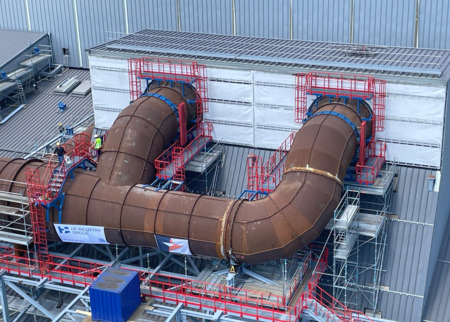
Despite this complexity, the most recent lifts of the extraction ducts went smoothly—a success attributable to careful preparation and close collaboration among all parties involved.
For the entire team, every successfully completed lift is a special moment. The best moment is often when the component has arrived safely at its destination and everyone involved knows that the plan has worked out.
Each of these moments marks another milestone in the project’s progress. The successful installation of the first section of the exhaust ducts is thus not only a technical achievement but also a testament to the competence and professionalism of the entire project team.
With the second phase scheduled for early July, the next important step is already on the horizon—and with it, another opportunity to demonstrate meticulous planning and collaboration.