Sustainable Production
New Environmental Standards in Steel Production
Steel Production and Plastic Article Design with a Sustainable Approach
Sustainable production processes and the use of environmentally friendly technologies combined with the uncompromisingly high quality of our products have been firmly anchored in our corporate philosophy for decades. At our plants in Hagfors (Sweden), Kapfenberg and Mürzzuschlag (Austria), we not only set standards in production quality and process reliability, but also in environmental standards. As part of our sustainability program inSPire, a particular focus is on the area of “Climate Impact” – with the clear aim of significantly reducing our Scope 1 and Scope 2 emissions through even more efficient use of energy.
Plastic Article Design with a Sustainable Approach
At voestalpine, we are committed to pioneering innovative technologies and targeted solutions to help reduce the product carbon footprint (PCF) of our customers’ plastic components. Key advancements include
»Ensuring unrestricted recyclability with enabling hard/soft surface properties in rigid one-component through functional texturing.
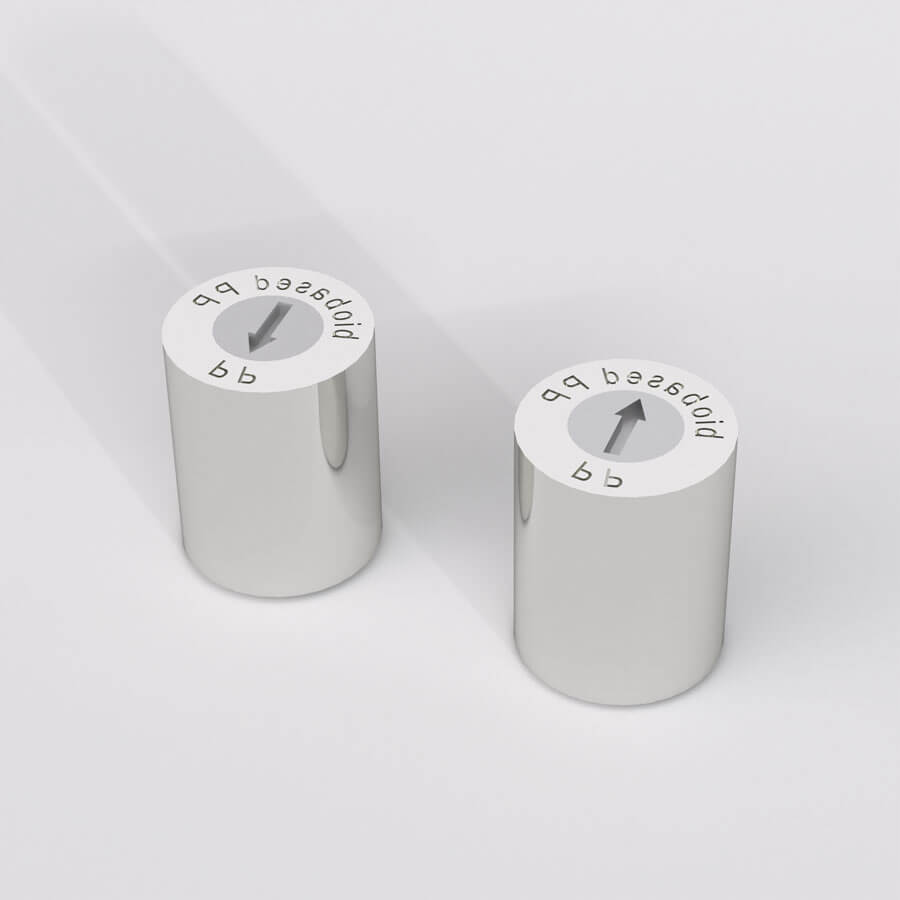
»Embedding invisible watermarks on product surfaces (Digimarc) to facilitate efficient and unmixed material separation in recycling processes.
»Reducing cycle times and minimizing scrap in the injection molding process with conformal cooling.
»Streamlining process chains and reducing machining volume through additive manufacturing.
»Extending tool life by utilizing wear-resistant materials and PVD coatings, offering enhanced protection of microstructures.
CO2-Neutral Article Production
Together with our partner De Beer Beoplast, we also focus on sustainability in the production of molded plastic parts and combine our knowledge of CO2-neutral processing of biobased plastics to support our customers in reducing CO2 emissions along the supply chain. De Beer Beoplast is the first completely emission-free and CO2-neutral plastics plant in Europe specializing in the sustainable production of plastic products and is certified accordingly:
- ISO 14064-3 Climate Neutral (TÜV)
- ISO 50001 Energy Audit (TÜV)
- ISO 14001 Environmental Audit (TÜV)
Optimizing TCO and CO₂ Emissions in Injection Molding
A holistic evaluation of injection molds requires both costs and CO₂ emissions to be considered across the entire lifecycle. The TCO₂ assessment combines Total Cost of Ownership (TCO) with CO₂ emissions to identify relevant levers for both economic and environmental optimization.
The assessment considers four key phases of the mold lifecycle: Tool Development, Tool Making, Tool Use and End-of-Tool Life. Relevant levers range from product and mold design and manufacturing routes to process optimization, machine technology, material use and recycling.
Using the voestalpine Coffee Cup and Lid Mold as a technology carrier, the project evaluated how mold design, process parameters and machine technology influence costs, CO₂ emissions and part quality.
Finding the Optimal Process Point
In injection molding, process parameters influence cycle time, part quality and energy consumption. Understanding how these factors interact is crucial for finding the optimal process point.
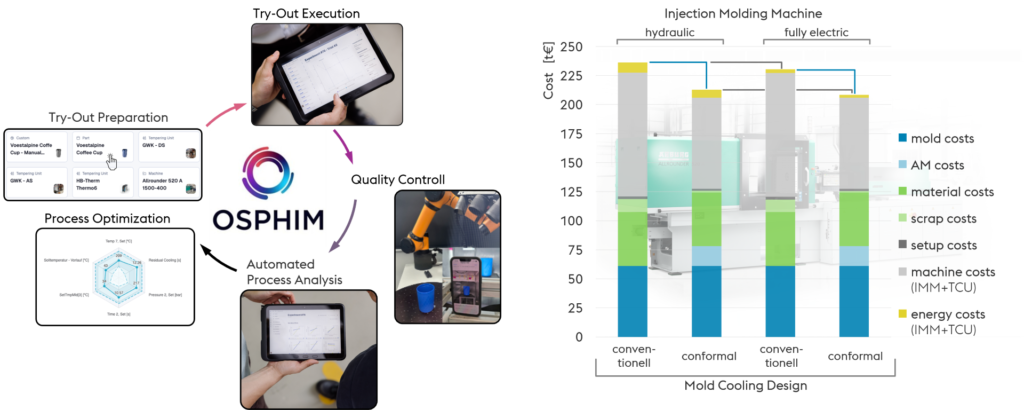
For the Coffee Cup project, an AI-based optimization approach from Osphim was used. Based on a guided Design of Experiments (DoE), in which the parameter limits are defined by experts, optimal process parameters were determined with a minimum number of trials. The experimental data was then evaluated using sensitivity analyses and optimization algorithms to identify the key influencing factors and derive the optimal process point.
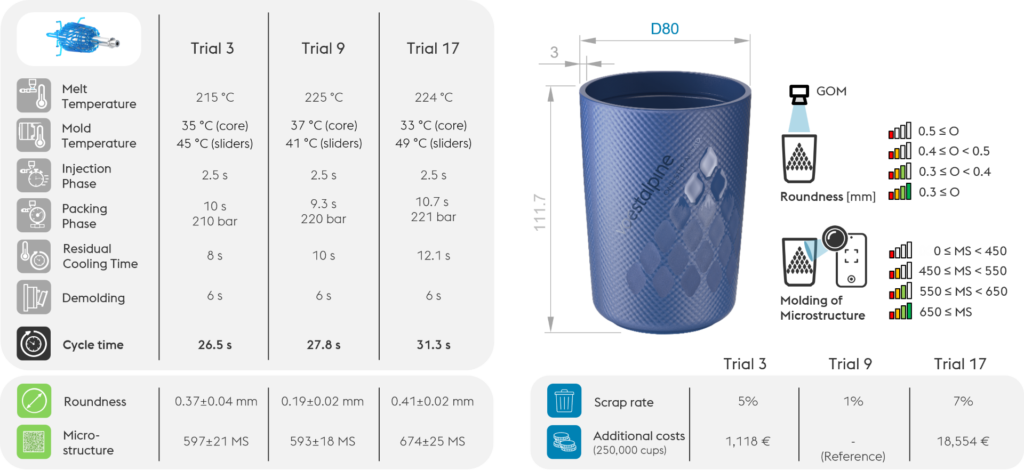
The main factors influencing TCO are cycle time and the scrap rate. For a production volume of 250,000 parts, the optimal test point had a slightly longer cycle time (+1.3 seconds) compared with another test point but resulted in approximately €1,100 lower costs due to the lower scrap rate.
Another test point achieved better surface quality, but a higher scrap rate due to greater deviations in roundness, combined with a longer cycle time (+3.5 seconds), resulted in approximately €18,500 in additional costs.
Influence of Mold Design and Machine Technology
The results also show that mold design, particularly temperature control, as well as machine technology can have a significant impact on total costs and CO₂ emissions.
Despite higher initial mold costs, the conformal cooling variant exhibited a lower TCO over a production volume of 250,000 shots. The main drivers were the shorter cycle time and lower scrap rate, resulting in cost savings in the range of €22,000. At the same time, the shorter cycle time reduced energy consumption, enabling a reduction of approximately 800 kg CO₂e.
Machine technology also had a significant impact. Switching from a fully electric injection molding machine to a hydraulic machine resulted in additional emissions of approximately 5,000 kg CO₂e and additional costs of around €4,300.
Reducing TCO and CO₂e
The results show that the combination of data-driven process optimization, innovative mold design and energy-efficient machine technology makes it possible to significantly reduce both costs and CO₂e.
Considered across the complete mold lifecycle, the TCO₂ approach provides a basis for identifying where technology, process and material decisions offer potential for economic and environmental optimization.