-
 News & EventsSubscribe to our newsletter
News from the world of wire

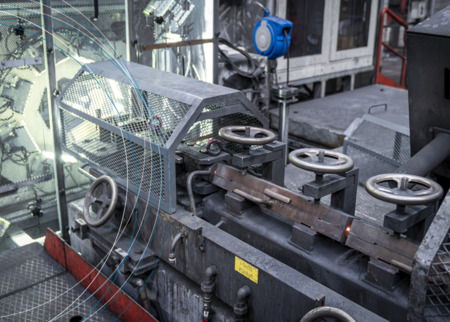
Highest quality does not begin with the finished wire product, but long before it. Deviations in surface finish, geometry, or material arise early in the process and have an impact throughout the entire value chain. voestalpine Wire Technology therefore follows a consistent approach: quality assurance begins with the raw material, is monitored in real time, and is continuously refined through research and development. This is based on a seamless, networked inspection chain that accompanies all process stages from raw material to end product.
The foundation of any stable wire production is defect-free pre-material. The stability of the material for processing in subsequent steps is determined as early as the billet stage. Comprehensive inline inspection systems are used in raw material production. Surface and profile quality are monitored under real rolling conditions - at high temperatures, in dusty environments, and under mechanical stress. Optical and laser-based measurement systems continuously record profile, straightness, and surface condition.
The goal is not only to detect defects but also to classify them early on. Deviations can lead immediately to process adjustments, such as in the rolling gap, temperature control, or straightening processes. This reduces scrap, avoids rework, and stabilizes further processing.
Despite automation, manual final approval remains a central component of quality assurance. Automated systems provide data, trends, and early warning signals - the standard-compliant quality decision remains in the hands of experienced specialists.
Thanks to collaboration among experts from our companies, as well as digitalization and AI, we create tangible added value across company boundaries along the entire value chain.
In wire production, every meter is inspected inline. Combined eddy current, optical, and camera-based systems are used, which deliver reliable data even at high speeds.
Eddy current testing detects near-surface defects with depth information, while high-speed cameras capture the entire wire surface. AI-supported image analysis complements the inspection through classification and pattern recognition. Only the interaction of these technologies enables a robust evaluation.
Realistic classification is key: 100% inspection does not mean absolute flawlessness, but rather complete transparency - especially regarding the location, type, and severity of potential anomalies.
Learn more in Podcast Episode 8 on the topic of "Testing expertise for pre-materials".
A key feature of the inspection chain is cross-system networking. Inspection data is combined with process parameters from rolling, cooling, and drawing. This allows for targeted analysis of correlations - such as whether defects are process-related, follow specific patterns, or occur only sporadically.
This transparency enables not only rapid responses but also preventive action. Deviations are detected early, before they become production issues. At the same time, a continuous digital product data set is created that can be used for both internal process optimization and external traceability.
At voestalpine Wire Technology, research and development are closely integrated into ongoing production. New inspection systems are developed in response to specific practical requirements—such as increasing production speeds, more complex wire geometries, or growing demands on surface quality.
A key focus is on the in-house development of AI-based inspection systems. Off-the-shelf solutions often reach their limits under real production conditions, for example due to high temperatures, large data volumes, or a lack of transparency in the algorithms. In-house developments ensure data sovereignty and enable targeted adaptation to the respective processes. In addition, voestalpine Wire Technology works closely with research institutes and universities.
Learn more in Podcast Episode 9 on the topic of "Testing expertise for wire".
For customers, this approach means, above all, process reliability. Defects are detected and evaluated internally before the material leaves the production line. This reduces downtime, unplanned tool changes, and scrap in downstream processes. In particular, the precise localization of anomalies enables predictable and stable further processing.
The trend is moving toward predictive quality: In the future, AI models will not only detect defects but also predict their occurrence and provide recommendations for action in real time. Quality will thus no longer be merely monitored but actively managed throughout the entire value chain.
If you have any questions or suggestions, please don't hesitate to contact us. We're happy to help!
