Reading time: 14 minutes
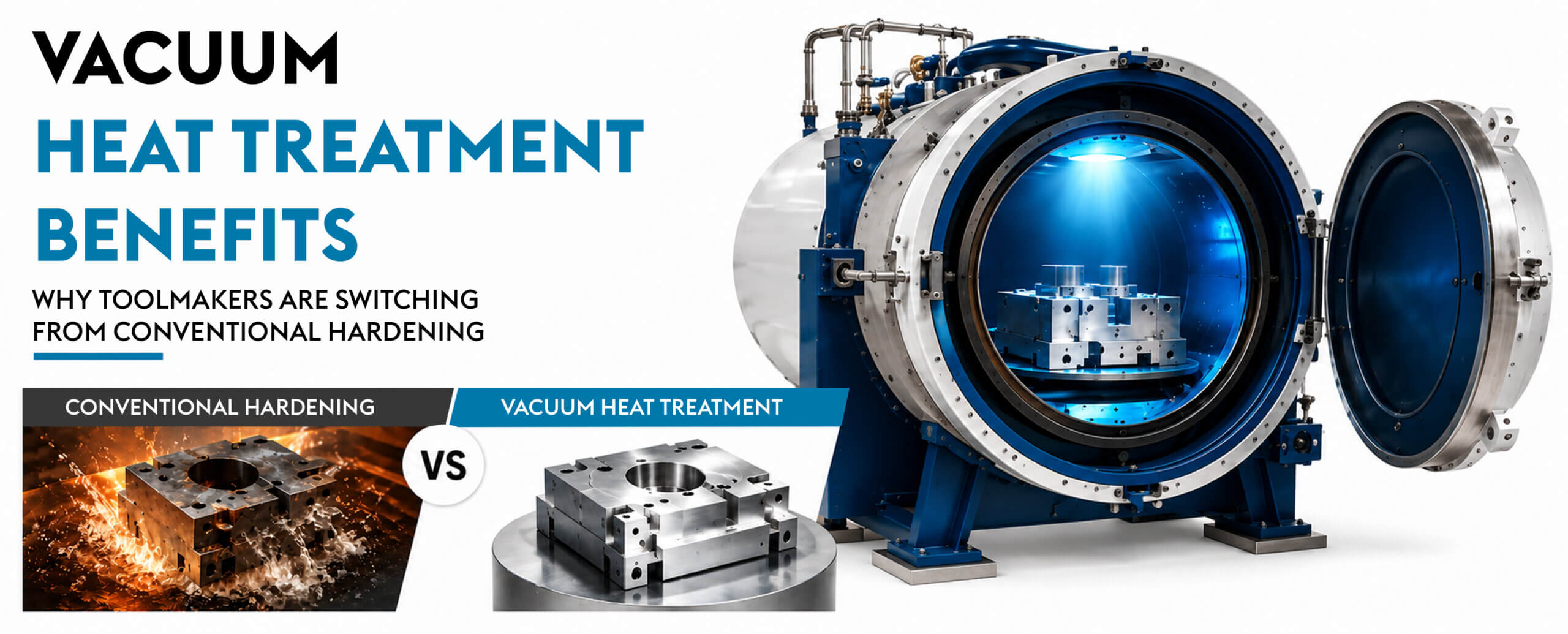
Vacuum Heat Treatment Benefits: Why Toolmakers Are Switching from Conventional Hardening
What Is Vacuum Heat Treatment?
The vacuum heat treatment benefits covered in this guide all trace back to one thing: vacuum heat treatment is a hardening process carried out inside a sealed chamber from which the air has been evacuated, so components are heated and quenched in an oxygen-free environment. It’s one of several types of heat treatment processes used in tooling, but the only one that removes oxygen from the equation entirely. Because there is no oxygen, nitrogen or moisture to react with the steel surface, parts emerge bright, clean, free of scale and free of decarburisation — with dimensions almost identical to how they went in.
The chamber is typically pumped down to a vacuum level between 10⁻² and 10⁻⁵ mbar. Heating is done by graphite or molybdenum elements, and quenching is achieved with high-pressure inert gas — usually nitrogen at 2 to 10 bar — rather than oil, water or molten salt.
In short: conventional hardening protects the metallurgy and then damages the surface. Vacuum heat treatment protects both — and that trade-off is the root of every one of the vacuum heat treatment benefits covered below.
How the Vacuum Heat Treatment Process Works
The sequence is what makes the difference:
- Loading and evacuation. Operators clean, fixture and load the parts, then seal the chamber and pump it down to the working vacuum.
- Stepped heating through holding stages. Instead of ramping straight to austenitising temperature, the furnace brings the load up in stages with deliberate holding (equalisation) stages. Each stage lets the component’s core catch up with its edge, so the temperature difference across the section stays small. This is the single biggest reason vacuum-hardened parts distort so little — thermal stress never gets the chance to build up.
- Austenitising soak. The load is held at the grade-specific hardening temperature (roughly 800–1,100 °C for most tool steels, up to 1,230 °C for high speed steels) long enough for carbides to dissolve uniformly.
- High-pressure gas quenching. Nitrogen is injected and circulated at high pressure and velocity. Quench rate is tuned by adjusting gas pressure and fan speed — a level of control that is simply not available with an oil tank.
- Multiple tempering. Parts are tempered two or three times, each with a full cool to room temperature, to transform retained austenite and stabilise dimensions.
- Optional cryogenic step. For high-alloy and PM grades, a deep-freeze cycle down to −196 °C between quench and temper converts stubborn retained austenite that tempering alone cannot reach.
Top 12 Vacuum Heat Treatment Benefits
1. No Oxidation, No Scale — a Bright, Clean Surface
With no oxygen present, the surface cannot oxidise. Components come out of the furnace with a bright, silvery, metallic finish that needs no shot blasting, pickling or descaling. For polished mould cavities and textured surfaces, this alone justifies the process.
2. Zero Decarburisation
Decarburisation — the loss of carbon from the surface layer at high temperature — leaves a soft, weak skin that toolmakers must grind away. In vacuum, no oxidising atmosphere remains to strip carbon, so surface hardness matches core hardness. No soft skin, no mandatory grinding allowance.
3. Dramatically Reduced Distortion
Stepped heating with equalisation stages, uniform radiant heating, and a gas quench that can be dialled in to the exact severity required all combine to keep distortion to a fraction of what oil or water quenching produces. For long, thin, or asymmetric parts — die plates, slender punches, blade steels — this is often the deciding factor.
4. Minimal Post-Hardening Machining and Rework
Because parts come out bright, dimensionally stable and free of a decarburised layer, the finishing stock you have to leave on drops sharply. Many components can be finish-machined before hardening and go almost straight to assembly. Less grinding means lower cost, shorter lead time, and no risk of grinding burns.
5. Precise, Repeatable Process Control
Operators programme and record every parameter — vacuum level, ramp rate, soak time, gas pressure, fan speed, cooling curve. The result is a fully documented, repeatable cycle with a furnace chart you can attach to your quality file. In practice, batch-to-batch consistency is a genuine engineering advantage, not just a paperwork one.
6. Longer Tool Life and Better Wear Resistance
A clean, fully hardened surface with no decarburised layer and correctly transformed retained austenite resists abrasive and adhesive wear far better. In cold work tooling and die casting dies, this commonly translates into substantially more shots between refurbishments.
7. Improved Toughness and Fatigue Strength
Lower residual stress and a defect-free surface mean fewer crack-initiation sites. Vacuum-hardened tools are markedly less prone to the quench cracking and early chipping that plague severely quenched parts.
8. Better Corrosion Behaviour
For stainless and corrosion-resistant plastic mould steels, vacuum processing preserves the chromium-rich passive layer instead of contaminating or oxidising it. The part retains the corrosion resistance the grade was chosen for.
9. The Right Base for PVD and DLC Coatings
PVD coatings demand an atomically clean, undamaged, dimensionally stable substrate. A vacuum-hardened surface is exactly that. It is why vacuum hardening is the standard preparation step before PVD or duplex treatment (plasma nitriding followed by PVD).
10. Clean, Safe and Environmentally Sound
There is no quench oil to store, filter, dispose of or catch fire, and no molten salt bath with its toxic residues and effluent-treatment burden. Vacuum furnaces produce no smoke, no fumes and no hazardous waste stream — a growing consideration as Indian environmental compliance tightens.
11. Flexibility Across a Wide Range of Materials
One furnace can process hot work and cold work tool steels, high speed steels, powder metallurgy grades, stainless and corrosion-resistant mould steels, maraging steels, and many nickel and titanium alloys — with quench severity adjusted per grade rather than per tank.
12. Lower True Cost per Component
The furnace cycle costs more per hour than an oil quench. But once you add back the grinding you did not do, the scrap you did not generate, the rework you did not schedule and the tool life you gained, the total cost of ownership is usually lower — sometimes substantially so on high-value tooling.
Vacuum Heat Treatment vs Conventional Methods
| Factor | Vacuum Heat Treatment | Salt Bath Hardening | Oil Quench Hardening |
| Surface condition | Bright, clean, scale-free | Salt residue, needs washing | Oily, scaled, needs cleaning |
| Decarburisation | None | Low to moderate | Moderate to high |
| Distortion | Very low, controllable | Moderate | High |
| Quench control | Programmable (gas pressure + velocity) | Limited | Very limited |
| Post-treatment work | Minimal | Washing + some grinding | Descaling + grinding |
| Suitability for PVD coating | Excellent | Requires extra prep | Poor without rework |
| Environmental impact | Very low, no waste stream | Toxic salts, effluent | Oil disposal, fire and fume risk |
| Process documentation | Full digital records | Basic | Basic |
| Ideal for | Precision moulds, dies, HSS, PM steels | High-volume small parts | Simple bulk components |
Which Materials and Components Benefit Most?
The vacuum heat treatment benefits above deliver the greatest return where surface quality, dimensional accuracy and tool value are all high:
- Plastic injection moulds and cavity inserts — polished and textured surfaces survive hardening intact.
- High-pressure die casting dies — thermal fatigue resistance and low distortion are critical.
- Cold work tooling — blanking punches, fine-blanking dies, forming tools, industrial knives.
- Hot work tooling — forging dies, extrusion dies and mandrels.
- High speed steel and PM cutting tools — end mills, broaches, hobs, reamers.
- Aerospace and medical components — where traceability and documented process control are mandatory.
- Long, slender or asymmetric parts — shafts, blades, ejector components, thin plates.
- Anything destined for PVD or DLC coating.
Simple, low-value, high-volume parts in plain carbon steel are usually still more economical through conventional routes. The honest answer is that vacuum is not always the right choice — it is the right choice when the part is worth protecting.
What to Look for in a Vacuum Heat Treatment Service Provider
If you are evaluating a provider to actually deliver these vacuum heat treatment benefits, ask for these six things before you send a single die:
- Calibrated and validated equipment. Furnace uniformity surveys and instrument calibration should be periodic and documented, not on request.
- High-pressure gas quenching capability. Ask the actual bar rating. Higher achievable pressure means a wider range of grades can be hardened successfully.
- Grade-specific cycles, not generic recipes. The provider should ask what steel grade, what hardness target, what application — before quoting.
- In-house metallurgical laboratory. Hardness testing and microstructural verification close the loop. Without them, you are trusting a number on a delivery note.
- Cryogenic and stress relieving under the same roof. Retained austenite control and pre-hardening stress relief are part of the same job, not separate errands.
- Materials expertise, not just furnace time. The best outcomes come from someone who understands the steel as well as the cycle — ideally the people who supplied it.
Common Misconceptions About Vacuum Hardening
“Vacuum heat treatment eliminates distortion completely.”
It reduces distortion dramatically but cannot eliminate it. Residual stress from rough machining, EDM and welding must still be removed by stress relieving before hardening. No furnace can undo bad pre-machining practice.
“Gas quenching is too slow for high-hardness grades.”
Modern high-pressure systems at 10–20 bar with high gas velocity achieve quench rates suitable for the great majority of alloy tool steels, high speed steels and PM grades. Grade selection matters — very low-alloy, low-hardenability steels are the genuine exception.
“Vacuum hardening is a surface treatment.”
It is not. Vacuum hardening is a through-hardening process: the entire cross-section transforms and carries the required properties. The vacuum protects the surface; the hardening happens throughout.
“Tempering once is enough.”
For alloy and high speed tool steels it is not. Two or three tempers, each with a full cool between cycles, are needed to bring retained austenite down and stabilise dimensions.
Frequently Asked Questions
1. What are the main benefits of vacuum heat treatment?
The main benefits of vacuum heat treatment are a bright, oxide-free surface with no scale, zero decarburisation, significantly reduced distortion, minimal post-hardening machining and rework, fully repeatable and documented process control, longer tool life through better wear resistance, and a clean process with no oil or salt waste. It is also the preferred base treatment before PVD coating.
2. How is vacuum heat treatment different from conventional hardening?
Conventional hardening takes place in air or a controlled atmosphere and quenches in oil, water or molten salt, which causes scale, decarburisation and higher distortion. Vacuum heat treatment removes the atmosphere entirely and quenches with high-pressure inert nitrogen gas, so the surface stays chemically unchanged and the quench rate can be precisely programmed rather than fixed by the medium.
3. Does vacuum heat treatment prevent distortion?
It reduces distortion substantially but does not eliminate it. Stepped heating with equalisation holding stages keeps the core-to-edge temperature difference small, and adjustable gas quenching avoids the thermal shock of liquid quenching. However, residual stresses from machining, EDM or welding must still be removed by stress relieving before hardening, and part geometry still matters.
4. Which materials can be vacuum heat treated?
Vacuum heat treatment suits hot work and cold work tool steels, high speed steels, powder metallurgy grades, stainless and corrosion-resistant plastic mould steels, maraging and precipitation-hardening steels, and many nickel-base and titanium alloys. Very low-alloy carbon steels with low hardenability are generally better suited to faster liquid quenching.
5. Is vacuum heat treatment more expensive?
The furnace cycle itself costs more per hour than oil or salt hardening. However, the total cost is usually lower for valuable components because parts need little or no descaling and grinding, scrap and rework rates fall, lead times shorten, and tool life increases. For precision moulds, dies and coated tooling, vacuum hardening is typically the more economical route overall.
Vacuum Heat Treatment You Can Trust — voestalpine High Performance Metals India
Realising all twelve vacuum heat treatment benefits in practice depends on three things: the correct steel grade, validated equipment, and metallurgists who understand both.
Voestalpine High Performance Metals India Pvt. Ltd. — a 100% subsidiary of the High Performance Metals Division of the voestalpine Group, the global market leader in tool steel — began heat treatment operations in India in 2004 at Chennai, and today operates facilities at Chennai, Mumbai and Delhi. All our equipment and processes are periodically validated and calibrated, and we deliver steel and heat treatment as a single package with the right tooling solution.
Our heat treatment and surface services:
- High-Pressure Vacuum Hardening (VHT) — higher material strength, better wear resistance and improved corrosion behaviour, with stepped holding stages that keep thermal stress and distortion to a minimum.
- Cryogenic Treatment — not a surface treatment but a through-treatment affecting the entire mass of the tool, converting retained austenite and making the component stronger throughout.
- Stress Relieving — controlled sub-critical cycles that stabilise machined and welded tooling before hardening.
- PVD and DLC Coatings by voestalpine eifeler, including duplex treatment (plasma nitriding + PVD).
- Metallurgical Laboratory — hardness testing, microstructural analysis and failure investigation by an experienced team.
- Engineered Products — finished and semi-finished components, conventional and additive (3D) manufacturing.
Backed by the world-leading brands under our umbrella — BÖHLER, UDDEHOLM, voestalpine eifeler and Eschmann Textures India — serving the automotive, consumer goods, food and beverage, medical, aerospace, oil and gas, and mining industries across India.
Explore our services: Vacuum Heat Treatment · Heat Treatment Overview · Cryogenic Treatment · Stress Relieving · PVD & DLC Coatings · Metallurgical Laboratory · Tool Steel Range
voestalpine High Performance Metals India — one step ahead in high performance materials and tooling solutions.