Reading time: 10 minutes
The Right Grade, The Right Results: Optimizing Tool Performance with BÖHLER Steels
The steel grade you choose plays a major role in determining the performance of the tool you get. Every tool follows the same fundamental tooling cycle: it is loaded into a machine, it performs its function dozens or millions of times, and eventually it wears out or fails. The length of that cycle and how effectively the tool operates along the way are determined by one decision made long before the tool is built: selecting the right steel grade.
Choose a slightly different grade, and even a well-made tool will chip, crack, wear out prematurely, or bend out of shape. Choose the appropriate one, and the same design can last much longer, maintain its shape, and generate consistent parts.
While selecting the right steel grade is crucial, an equally important question, though often overlooked, remains: even if you’ve chosen the correct grade on paper, does the steel you receive function as expected? This is where the steel supplier, specifically BÖHLER, plays a critical role.
What Determines the Right Steel Grade?
There is no single “best”tool steel. While every application demands a unique combination of characteristics, improving one characteristic often means compromising another. The main properties to consider include:
- Wear Resistance: How thetool resists gradual surface wear from repeated contact with material.
- Toughness: How well it resists chipping or cracking under impact or shock loads.
- Hardness: How well it holds its cutting edge or resists being deformed under pressure.
- Dimensional Stability: How little it moves or distorts during heat treatment and use.
- Operating Temperature: How well it keeps its strength and hardness when things heat up.
Cold work tool steels are a good example, as these steels are designed for tools that do not typically reach temperatures above 200°C. However, friction or certain plastics processing can occasionally push temperatures above 300°C. Within these conditions, cold work grades must simultaneously combine high hardness, high wear resistance, good toughness, and resistance to impact and fatigue.
This balance is critical, as toolmakers rarely optimise for a single feature or characteristic. A cold-heading punch that has been over-hardened may fail sooner than expected due to sharp corners and deep cavities that prioritise impact resistance over raw hardness. In practice, the best steel grade is not the one with the highest hardness or the most impressive specification sheet; it is the one that provides the optimal balance of properties for the specific application.
Match the Grade with the Tooling Challenge
Rather than thinking of grade selection as choosing from a catalogue, it helps to think in terms of the application itself.
Cutting tool applications, which include milling, drilling, and general machining tools, rely heavily on steel grades that offer hardness, wear resistance, and the ability to remain hard even when hot.
Cold-work applications, such as stamping dies, blanking tools, and forming tools, require steel grades that provide better wear resistance, hardness, and high edge retention.
Plastic mould applications, including automobile components, medical parts, and precision moulds, require steel grades selected for their polishability, corrosion resistance, and dimensional stability.
Hot-work applications, such as die casting and forging tools, require steel grades with excellent thermal fatigue resistance, high-temperature strength, and toughness.
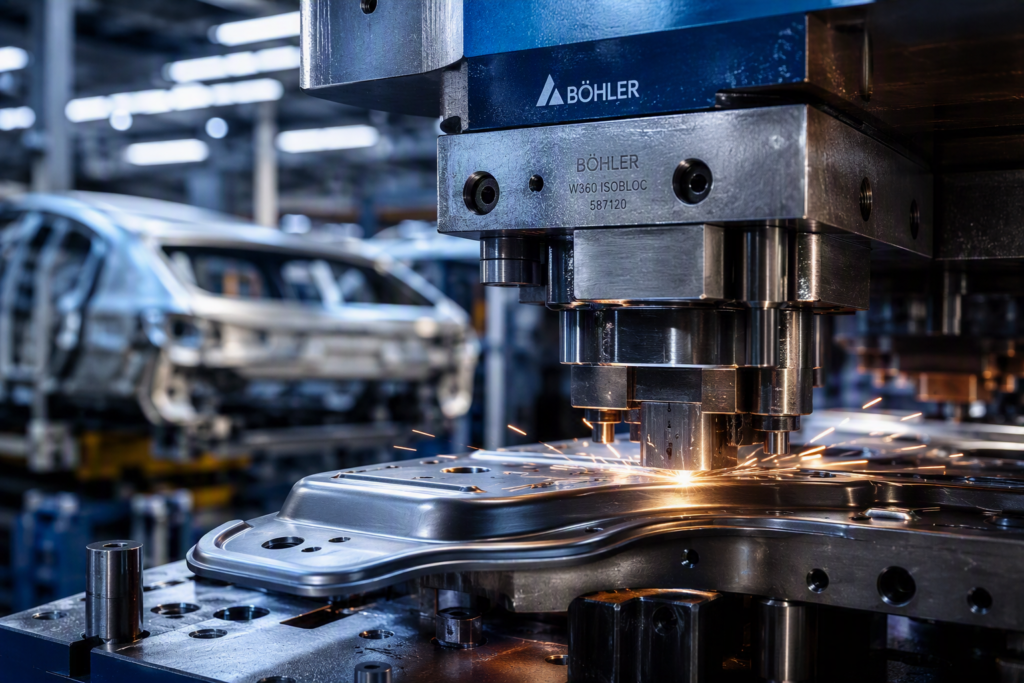
The key takeaway is straightforward: BÖHLER grade selection starts with understanding what the application demands, not with picking a material in advance and then hoping it’s suitable. The following table categorizes different BÖHLER grades developed for specific tooling requirements and operating conditions:
| BÖHLER Grade | Category | Typical Applications | Suited Industries | Key Characteristics |
| K110 | Cold Work | Blanking dies, punches, thread rolling tools, cutting tools | General engineering, sheet metal, fastener manufacturing | Good wear resistance, moderate toughness, reliable all-rounder |
| K340 | Cold Work | Stamping dies, forming tools, cold extrusion punches | Automotive stamping, appliance parts | Balanced wear resistance and toughness, good dimensional stability |
| K390PM/ K490PM | Cold Work (PM) | High-precision blanking, fine-blanking dies, cold heading punches | Precision fastener, electronics stamping | High wear resistance with improved toughness via powder metallurgy |
| W302 | Hot Work | Die casting dies, forging dies, hot extrusion tools | Aluminium/zinc die casting, forging | Good hot toughness, high hot hardness, resists thermal fatigue |
| W350 / W360 | Hot Work (premium) | Large die-casting moulds, high-stress forging inserts | Automotive die casting, heavy forging | Superior thermal fatigue resistance, higher hot wear resistance |
| W400 / W403 (VMR) | Hot Work (remelted) | Large die-casting tools, precision forging dies | High-volume die casting | Very high heat-checking resistance, excellent cleanliness (fewer inclusions) |
| M303HH | Plastic Mould | Moulds for PVC and corrosive compounds, food-contact moulds | Food processing, medical, PVC processing | Corrosion resistant, good toughness, polishable |
| M310 / M340 | Plastic Mould | High-precision, high-gloss moulds | Automotive lighting, optical/lens moulds | Excellent polishability, stainless corrosion resistance |
| M390PM | Plastic Mould (PM) | Abrasive-filled plastic moulds (glass/mineral-filled resins) | Electronics, fibre-reinforced plastics | Very high wear resistance, good corrosion resistance |
| S600 / S690PM | Cutting Tools (HSS) | Drills, taps, milling cutters | General machining, metal cutting | Good hot hardness, reliable edge retention |
| S290PM / S390PM | Cutting Tools (PM-HSS) | High-performance cutting tools, broaches | Precision machining, aerospace | High wear resistance, superior toughness for interrupted cuts |
| S790PM | Cutting Tools (PM-HSS, premium) | Heavy-duty milling, high-speed cutting | High-volume machining, tooling manufacture | Extreme wear resistance, retains hardness at high cutting temperatures |
Why BÖHLER Tool Steel Grades Perform Differently, Even When the Specs Look the Same ?
BÖHLER often uses chemistry that is similar to other tool steel producers. Many of its grades fall within familiar, well-known steel families. The real difference is less visible: how the steel is melted, refined, and processed before it is used to make tools.
Steel purity plays a greater role than most shop floors realise. Non-metallic inclusions, or small residual impurities from the melting process, can gradually damage a tool from within. That’s why hot-work tool steel manufacturers work hard to keep these imperfections to a minimum, because purity is directly related to how long a tool can effectively serve its purpose.
The remelting process also plays an important role. Many high-performance steel grades undergo Electroslag Remelting (ESR), a refining process that results in a cleaner, more uniform internal structure. Without this step, the internal carbide particles that provide the steel’s wear resistance may become unevenly distributed, creating bands running through the material. If a tool is loaded in a direction that aligns with those bands, it may crack under stress in a way that no amount of careful heat treatment can repair. That decision is made in the mill, not the workshop.
This is the crux of the issue: two batches of steel can have the same grade name but behave quite differently in service, because grade name and heat treatment only tell part of the story; who melted the steel is just as important. BÖHLER’s manufacturing methods aim to reduce the gap by implementing stricter purity control, remelting, and speciality ranges such as ultra-pure powder metallurgy steels, resulting in more predictable and consistent results for the same nominal grade.
Why Getting the (BÖHLER) Grade Right Pays Off ?
When the grade and the source are both right, the benefits extend across the entire production line, not just the tool itself:
- Fewer failures that reduce chipping, cracking, premature wear, or warping.
- Less downtime, which ensures fewer unplanned stops for regrinding, repair, or full replacement.
- More consistent output, and so, parts stay within tolerance for longer, run after running.
- Lower overall cost, even if the steel itself costs more up front.
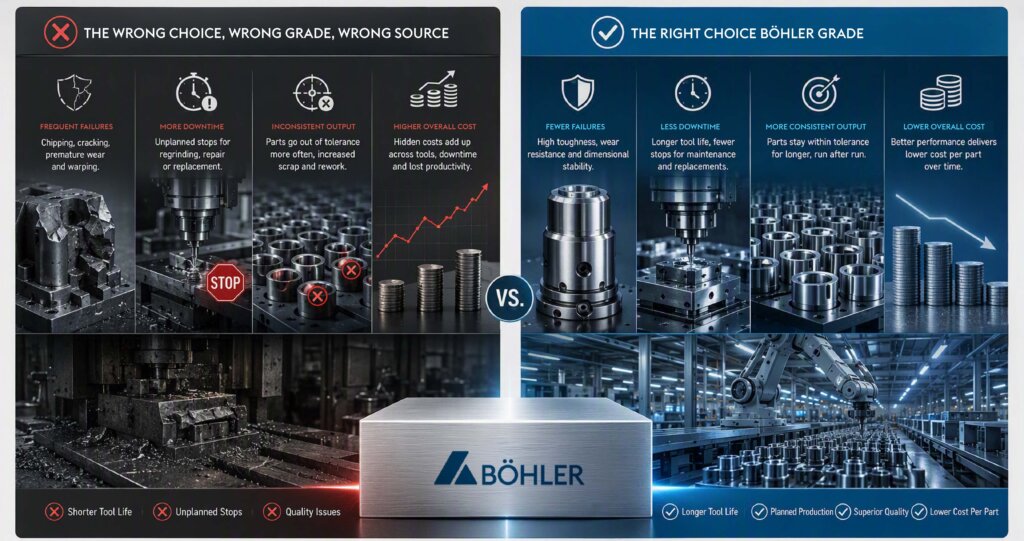
The last point is worth considering. A lower-cost steel that fails prematurely, requires more frequent maintenance, or produces inconsistent parts can often become more expensive in the long run. The cost per finished product, after accounting for downtime, scrap, and labour, is more important than the price per kilogram of steel. When seen in this light, investing in a grade with greater stability is often the more cost-effective choice in the long term.
Finding the Perfect Match: Application, Grade, and Source
Selecting the right tool steel ultimately comes down to three connected decisions: understanding what your application actually demands, choosing the grade whose properties match that demand, and making sure the steel you receive actually delivers what that grade promises. The first two steps are engineering decisions. The third one, a sourcing decision, is often overlooked. A grade is only as reliable as the consistency it reflects. Choosing a supplier should be considered just as important as selecting a grade, which is why many manufacturers choose BÖHLER.