Reading time: 13 minutes
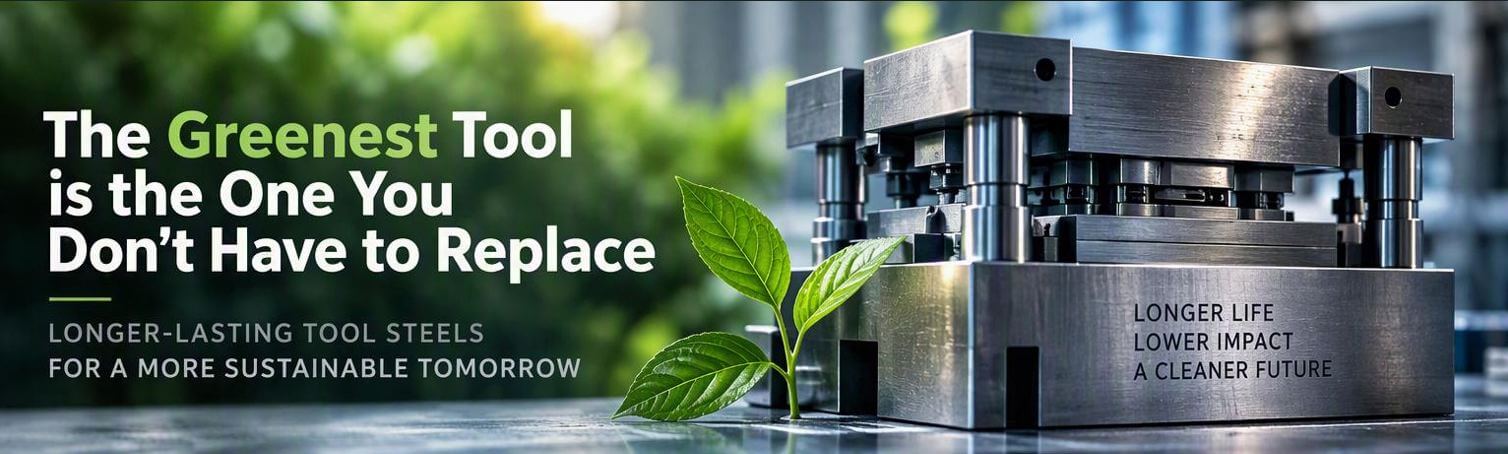
The Greenest Tool is the One You Don’t Have to Replace
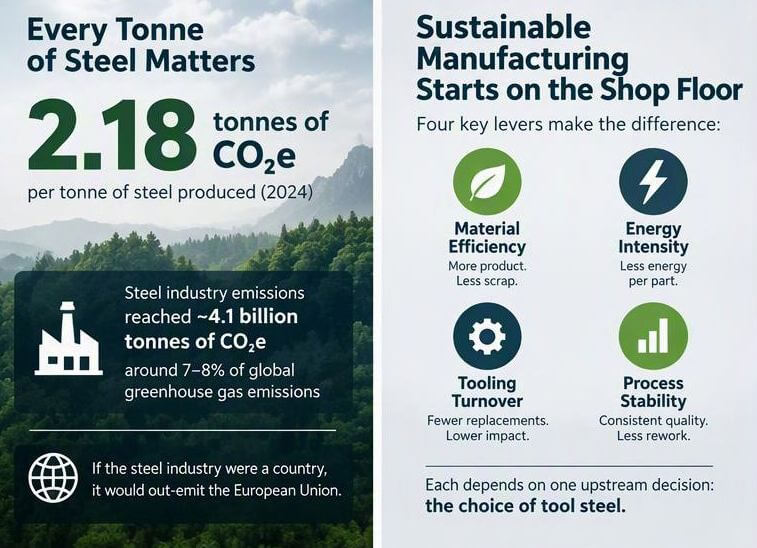
When every tone counts, the figures put the challenge into perspective. In 2024, every tone of steel produced accounted for an average of 2.18 tones of CO₂-equivalent across Scopes 1, 2 and 3. Sector emissions reached roughly 4.1 billion tones of CO₂e, equivalent to around 7–8% of global anthropogenic greenhouse gas emissions. If the steel industry were a country, it would out-emit the European Union.
Against this backdrop, sustainable manufacturing can sound like an abstraction reserved for annual reports. On the shop floor, it is anything but: a forming die that runs 400,000 strokes instead of 150,000; a punch that holds tolerance through three shifts instead of one.
Sustainability, at its most practical level, is tool life. And tool life begins with tool steel.
What Sustainable Manufacturing Means on the Shop Floor
Sustainable manufacturing minimises resource consumption, waste generation and environmental impact without sacrificing output, quality or economic viability. It is no longer niche. The global market, which stood at approximately USD 233.56 billion in 2025, is projected to reach USD 367.18 billion by 2029, an 11.3% compound annual growth rate. As regulations tighten, customer expectations rise, and energy costs increase, one thing becomes clear: waste is expensive.
For forming, cutting, stamping and moulding operations, the decisive levers sit closer to the process than most sustainability programmes assume. This implies focusing on four key areas:
● Material Efficiency: The proportion of raw material converted into finished product rather than scrap.
● Energy Intensity: The amount of energy consumed per finished part.
● Tooling Turnover: The frequency with which tools are manufactured, reground, re-coated, repaired or discarded.
● Process Stability: The ability to maintain consistent production without quality drift, rework or unplanned downtime.
Each ultimately depends on a single upstream decision: the choice of tool steel.
The Hidden Carbon Cost of a Worn-Out Tool
A tool that fails prematurely carries an environmental invoice that conventional carbon accounting rarely captures. Every replacement tool must be melted, forged, annealed, rough machined, heat treated, finish ground and frequently coated. The worn tool must be transported, reground or scrapped, while the press stands idle during the changeover.
The environmental impact may be hidden, but the financial mirror is well documented. Unplanned stoppages cost roughly 35% more per minute than planned downtime, and Plant Engineering research estimates emergency maintenance at three to five times the cost of the same repair performed on schedule. Siemens’ True Cost of Downtime 2024 report puts Fortune Global 500 losses at approximately USD 1.5 trillion annually, around 11% of total revenues.
Behind each percentage point sits wasted steel, energy and machine hours. Multiplied across the hundreds of tools in a typical plant, tooling longevity becomes one of the most underrated decarbonisation levers in manufacturing.
Why Conventional Tool Steels are Reaching their Limit
The pressure on tooling is intensifying. Today’s workpiece materials – advanced high-strength steels and fibre-reinforced polymers – are far more abrasive and demanding than those the classic grades were designed to form. Alloys that served for decades – D2, A2, S7 – are reaching their load limits.
In one documented automotive case, D2 tools capable of 50,000 load cycles forming conventional steel failed after 5,000–7,000 cycles when the part was converted to FB 600, a ferritic-bainitic advanced high-strength grade. Alternative grades at the same hardness (58–60 RC) delivered similar life and similar failures. Metallurgical analysis identified insufficient impact strength as the root cause.
The explanation lies in solidification. When poured into a large ingot and cooled slowly, alloying elements segregate rather than distribute evenly. The resulting carbides are coarse and unevenly dispersed, each one a stress concentrator. Under cyclic loading, the tool does not necessarily fail where the stress is the highest, but where the microstructure is the weakest.
How BÖHLER Tool Steels Extend Tool Life and Shrink Footprints
For more than 150 years, BÖHLER has engineered special steels at the limit of what metallurgy allows. Today, that capability contributes to more sustainable manufacturing through three key mechanisms:
1. Metallurgical Cleanliness and Homogeneity
Powder metallurgy attacks segregation at its origin. Molten steel is atomised by high-pressure inert gas into droplets of around 100 μm that freeze almost instantly, confining segregation to a fraction of the powder diameter. Hot isostatic pressing then consolidates it.
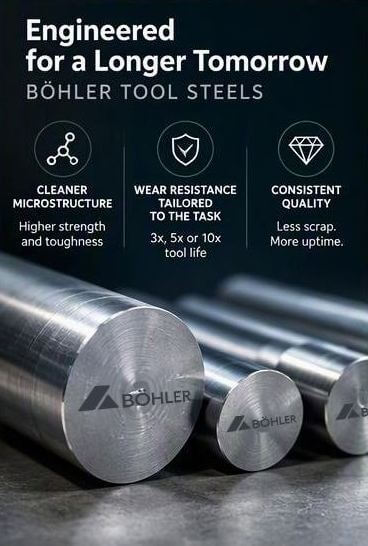
Carbides become fine and evenly distributed, resisting abrasive wear, adhesive wear, chipping and cracking at once, a combination that ingot metallurgy struggles to deliver, since hardness is normally bought at the cost of toughness. And with macro-segregation no longer limiting, alloying becomes possible beyond anything an ingot tolerates: BÖHLER K390 MICROCLEAN carries 9% vanadium at up to 64 HRC, combining outstanding wear resistance with good toughness.
In the documented automotive case mentioned above, conversion to a PM grade at identical hardness raised un-notched Charpy values nearly tenfold, along with a corresponding increase in tool life. A separate comparison put a PM cutting die at five times the life of an identical D2 die.
2. Wear Resistance Engineered to Failure Mode
There is no “universal best tool steel”, only the right steel for the failure mechanism. K390 MICROCLEAN answers abrasive wear and compressive loading in blanking and fine stamping. M390 MICROCLEAN, corrosion-resistant at ~60 HRC and food-contact approved, withstands the fibre-reinforced and chemically aggressive compounds that erode standard grades. S390 MICROCLEAN, 8% cobalt to 68 HRC, serves drilling, milling and cold forming. Matching steel to mechanism is where three-, five- or tenfold gains become realistic, and every extra multiple of tool life is one fewer set of replacement tools to manufacture.
3. Consistency that Protects Product Quality
Wear is not binary. Tools degrade progressively and parts degrade with them; dimensional drift, burrs and surface defects appear long before a tool is condemned. Scrap and rework already drain up to 2.2% of annual revenue, while restart phases after unplanned stops add a further 3–8%. Wear resistance, therefore, protects every part produced throughout a tool’s service life, including its final, degraded stage. Powder metallurgy’s uniform carbide distribution produces more even wear and less batch-to-batch variation, allowing regrind intervals to be set on evidence rather than caution.
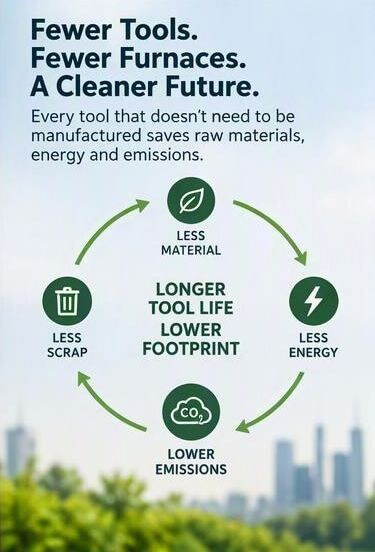
The Energy Equation: Fewer Tools, Fewer Furnaces
Every tool that need not be manufactured is energy that need not be spent and tool manufacturing sits at the energy-intensive end of the spectrum.
Melting alone consumes roughly 19 MJ/kg from iron ore, or 10 MJ/kg from scrap. Heat treatment compounds it: direct hardening in multi-purpose furnaces requires about 1 kWh per kilogram of charge, while vacuum hardening the standard route for tool steels consumes roughly twice that, because a multi-purpose furnace is charged into a chamber already above 750°C, whereas a vacuum furnace begins every cycle from ambient.
Maintenance carries its own recurring load. Every regrind consumes grinding energy; every re-coating means another PVD chamber pumped down and heated from cold. A tool reground eight times rather than 24 eliminates two-thirds of a cycle that never appears on a tooling invoice.
The arithmetic is multiplicative, not marginal: when tool life doubles, the embedded energy of the whole chain halves per part produced.
What Extended Tool Life Removes From the System
The material argument becomes concrete when the estate is modelled rather than described. Consider a plant running 200 active blanking tools, each carrying 40 kg of tool steel in its inserts, replaced three times a year on a conventional grade.
That estate consumes 24 tonnes of tool steel annually. At three times the tool life, it consumes 8 tonnes, 16 tonnes never melted, forged, machined, heat treated, ground or coated.
Melting alone accounts for around 44,000–84,000 kWh of the avoided total; vacuum hardening that tonnage would have consumed a further 32,000 kWh. That is 75,000–115,000 kWh not drawn, from two process steps out of seven, in one plant, in one year.
Worn-out tools return to the loop; steel is recyclable without loss of quality, which is why roughly 75% of all steel ever produced remains in use. But re-melting still costs around 10 MJ/kg: a tool never made is always cheaper than a tool to be recycled.
(Figures illustrative; substitute your own tool masses, estate size and replacement intervals for a first-order estimate.)
Where Longer Tool Life Pays Off
| Sustainability Levers | Effects of Extended Tool Life |
| Raw material consumption | Fewer replacement tools manufactured; less steel melted, forged and machined |
| Production waste | Lower scrap and rework from stable tool geometry; fewer restart quality losses |
| Energy consumption | Reduced energy across melting, heat treatment, coating, regrinding and logistics |
| Downtime and OEE | Fewer tool changes and unplanned stops; higher machine utilisation per kWh |
| Cost of quality | Consistent dimensions and surfaces across long runs, fewer rejections |
| Reporting and compliance | Lower embedded carbon per part, supported by verifiable product-level data |
From Claim to Data: Why Verification Matters Now
Extended tool life reduces the footprint only if the footprint is known. A tool lasting 10 times longer but originating from an unmeasured supply chain remains, in reporting terms, an unknown carbon footprint multiplied by 10.
That became a commercial reality on January 1, 2026, when the EU’s Carbon Border Adjustment Mechanism entered its definitive phase, pricing carbon at the border on iron and steel. Obligations fall on EU importers but propagate to their suppliers. Vendor selection, historically decided on price, delivery and quality, now carries a fourth axis: emissions transparency.
Three conditions must hold together: lower-carbon production, extended service life, and transparent product data.
- Lower-carbon Production: The Kapfenberg plant, the first of its type built in Europe in four decades, runs its electric arc furnace solely on green electricity, with waste heat recovery and 205,000 tonnes of annual capacity, while greentec steel targets a 50% Group CO₂ reduction from 2027.
- Extended Service Life: The MICROCLEAN powder-metallurgy portfolio is engineered to the way tools actually fail – K390 for abrasive wear, M390 for corrosion and aggressive polymers, S390 for high-speed cutting. It is where the three- to tenfold tool-life gains cited earlier are realised, turning each replacement avoided into material and energy never consumed.
- Transparent Product Data: Through eco2nboard, within the High Performance Metals Division’s inSPire framework, voestalpine BÖHLER Edelstahl calculates cradle-to-gate carbon footprint and recycled content at the product level, externally reviewed against ISO 14040, ISO 14044 and the GHG Protocol Product Life Cycle standard.
Productivity and Sustainability: No Longer a Trade-Off
Tooling challenges the old assumption that environmental performance costs competitiveness.
The productivity case is evidenced, not asserted. Process issues, including tooling problems, drive roughly 15% of unplanned downtime incidents. An ABB survey of 3,200 plant maintenance leaders found that two-thirds of companies stop unexpectedly at least monthly, at an average of USD 125,000 per hour. Tools that fail less often return machine hours, the scarcest asset on any shop floor.
Powder-metallurgical steels cost more per kilogram. That is the wrong denominator. A grade priced 40% higher but delivering three times the tool life, more than halves the cost per component, before counting avoided changeovers and scrap that never happened. Cost per kilogram is a purchasing metric; cost per part is a business one.
The properties are one list: durability, wear resistance, toughness, and consistency, simultaneously lowering the footprint and raising the output. Not two objectives. One, measured in two units.
The Bottom Line
Sustainable manufacturing is not built on grand gestures. It is built shift by shift and stroke by stroke, on decisions that compound: the die that outlasts its forecast, the punch that holds tolerance, the mould that keeps running. BÖHLER tool steels are engineered for exactly those performance margins and, increasingly, documented well enough to prove it.