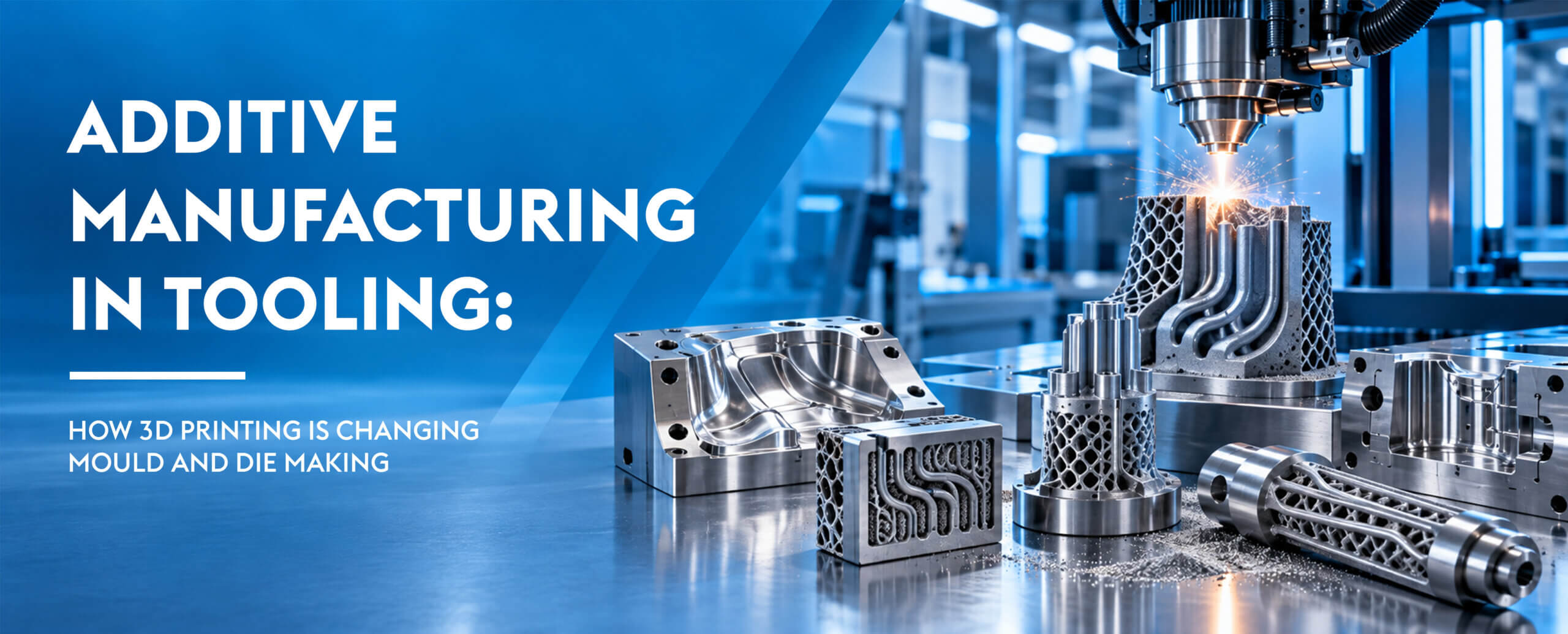
Additive Manufacturing in Tooling: How 3D Printing Is Changing Mould and Die Making
In short: Additive manufacturing in tooling uses metal 3D printing (mainly LPBF and LMD) to produce mould and die inserts — most commonly with conformal cooling channels that follow the part’s geometry. This shortens cycle times, improves temperature uniformity, reduces scrap, and extends tool life, while heat treatment, machining, and surface finishing are still applied afterward, just as they are with conventionally made tooling.
Conformal Cooling: The Biggest Use Case in AM Tooling
If there’s one application driving additive manufacturing’s adoption in tooling faster than anything else, it’s conformal cooling.
In high pressure die casting and plastic injection moulding, cooling channels traditionally have to be drilled in straight lines, which means they often sit far from curved or deep sections of the cavity — exactly the areas that need cooling the most. Conformal cooling channels, made possible by AM, follow the actual contour of the mould cavity. The result is a more homogeneous temperature distribution across the tool during the injection or casting cycle, which:
- Reduces part distortion and warping.
- Lowers scrap rates.
- Cuts cycle time by pulling heat out of hot spots faster.
- Improves overall dimensional consistency, shot after shot.
On top of that, the same design freedom that enables conformal cooling also allows channels for sensor integration — giving toolmakers real-time visibility into mould temperature and process conditions without interfering with the cooling layout itself.
The Additive Manufacturing Value Chain for Tooling
A common misconception is that AM tooling starts and ends with the printer. In practice, a production-ready printed insert passes through the same rigour as any other precision tool component — the printer is just one station in a longer value chain:
- Metal powder: Premium AM-grade tool steel powder, engineered for consistent chemistry, purity, and flowability.
- Parameter development: Process parameters tailored to the specific alloy and geometry to ensure repeatable part quality.
- Design and simulation: Conformal cooling layouts, internal channels, sensor integration paths, and weight-reduction structures are engineered and validated before a single layer is printed.
- Printing: Using LPBF or LMD, the insert is built layer by layer to near-full density.
- Heat treatment: Vacuum hardening, nitriding, or induction hardening to bring the printed part to its required strength, hardness, and wear resistance.
- Machining: Precision finishing to bring the insert to final tolerance, just as with conventionally forged or rolled tool steel.
- Surface texturing and coating: Laser texturing for functional or cosmetic surface finishes, and PVD coatings for wear protection and extended service life.
- Inspection and testing: Microstructure analysis, hardness testing, dimensional checks, and X-ray/CT inspection to confirm the part meets specification before it goes into production.
Every one of these steps affects whether a printed insert performs in the tool room the way it’s expected to. Skipping or under-investing in any single stage — powder quality, simulation, heat treatment, or inspection — is usually where AM tooling projects run into trouble.
Applications of AM Tooling Across Industries
Additive manufacturing has moved from experimental to genuinely production-proven across several tooling-heavy sectors:
- High Pressure Die Casting: Conformal-cooled inserts that reduce cycle time and improve casting quality in automotive and industrial components.
- Plastic Injection Moulding: Cavity and core inserts with conformal cooling that cut cycle times and reduce warping in complex plastic parts.
- Press Hardening: Tooling designed to manage heat distribution precisely during hot stamping processes.
- Oil & Gas / CPI: Components and tooling built to withstand demanding thermal and corrosive environments.
- Aerospace: Lightweight, high-strength printed components alongside tooling used in their production.
What to Consider Before Adopting AM Tooling
Additive manufacturing in tooling isn’t a drop-in replacement for every insert on the shop floor, and it’s worth being realistic about that:
- Cost per part: Conventional machining still tends to be more economical for simple geometries produced in high volumes. AM earns its place where geometry complexity, rather than part count, is the constraint.
- Design expertise matters: Getting the real benefit out of conformal cooling requires simulation-driven design, not just converting an existing insert geometry into a printed one.
- Qualification and validation: Printed parts need the same rigour around heat treatment, inspection, and testing as conventionally produced tooling, especially in regulated industries like aerospace and medical.
- Powder and process consistency: Consistent powder quality and well-developed process parameters are essential. Inconsistencies are among the reasons a printed insert may underperform in service.
Why Work with voestalpine for AM Tooling
voestalpine High Performance Metals India supports the complete additive manufacturing value chain for tooling — from premium BÖHLER and Uddeholm AM powders through parameter development, design and simulation, printing, heat treatment, machining, surface texturing, coating, and final inspection — as part of a global network that includes Additive Manufacturing Centers in Houston, Mississauga, Düsseldorf, Singapore, Dongguan, and Nantou, backed by dedicated powder production sites in Kapfenberg, Austria (BÖHLER) and Hagfors, Sweden (Uddeholm).
For Indian toolmakers, that means access to globally standardised AM processes, a quality vision built on customer focus and fact-based decision-making, and a single point of contact for material, process, and post-processing support instead of stitching together powder, printing, heat treatment, and finishing from separate vendors.
Frequently Asked Questions
1. What is additive manufacturing in tooling?
Additive manufacturing in tooling refers to using metal 3D printing processes — mainly LPBF and LMD — to produce mould and die inserts, most commonly with conformal cooling channels that follow the part’s geometry to improve cooling efficiency and tool performance.
2. What is the biggest benefit of additive manufacturing for tooling?
The biggest benefit is conformal cooling — cooling channels that follow the contour of the mould cavity, which shortens cycle times, reduces part distortion, and lowers scrap rates compared to conventionally drilled straight cooling channels.
3. Is 3D printed tooling as strong as conventionally machined tooling?
Yes, when the correct AM powder and process parameters are used, printed tooling inserts can achieve densities close to 99.997% and, after heat treatment, reach hardness and wear resistance comparable to conventionally produced tool steel.
4. Which tooling processes benefit most from additive manufacturing?
High pressure die casting and plastic injection moulding benefit the most from additive manufacturing, primarily through conformal-cooled inserts that reduce cycle time and improve part quality, with press hardening and oil & gas tooling also seeing significant adoption.
5. Can additive manufacturing repair existing tooling instead of replacing it?
Yes. Laser Metal Deposition (LMD) can add material directly onto existing tools and dies, making it well suited for repairing worn tooling, cladding wear-resistant layers, and extending the service life of high-value mould and die bases.
6. Does 3D printed tooling still need heat treatment and machining?
Yes. Printed inserts go through the same post-processing as conventional tooling — heat treatment for strength and hardness, precision machining for final tolerance, and often surface texturing or PVD coating for wear protection.
Bring Additive Manufacturing into Your Tool Room
If cycle time, tool life, or design complexity are limiting what your tooling can do, additive manufacturing may be the lever your process is missing. Our team can help you evaluate where conformal cooling and printed inserts make sense for your application, and guide you through material selection, design, and the full AM value chain from concept to production-ready tooling.
Talk to our Additive Manufacturing team at voestalpine High Performance Metals India →