Reading time: 8 minutes
Vacuum Heat Treatment vs. Conventional Heat Treatment: Why voestalpine’s Technology Sets a New Industry Benchmark
Heat treatment is one of the most critical stages in the manufacturing lifecycle of high‑performance tooling, precision components, and engineering steels. As industries push toward greater reliability, durability, and efficiency, the limitations of older heat‑treating technologies become increasingly evident. This is where voestalpine’s Vacuum Heat Treatment technology emerges as a transformative solution—offering superior metallurgical performance, better surface integrity, and highly consistent mechanical properties.
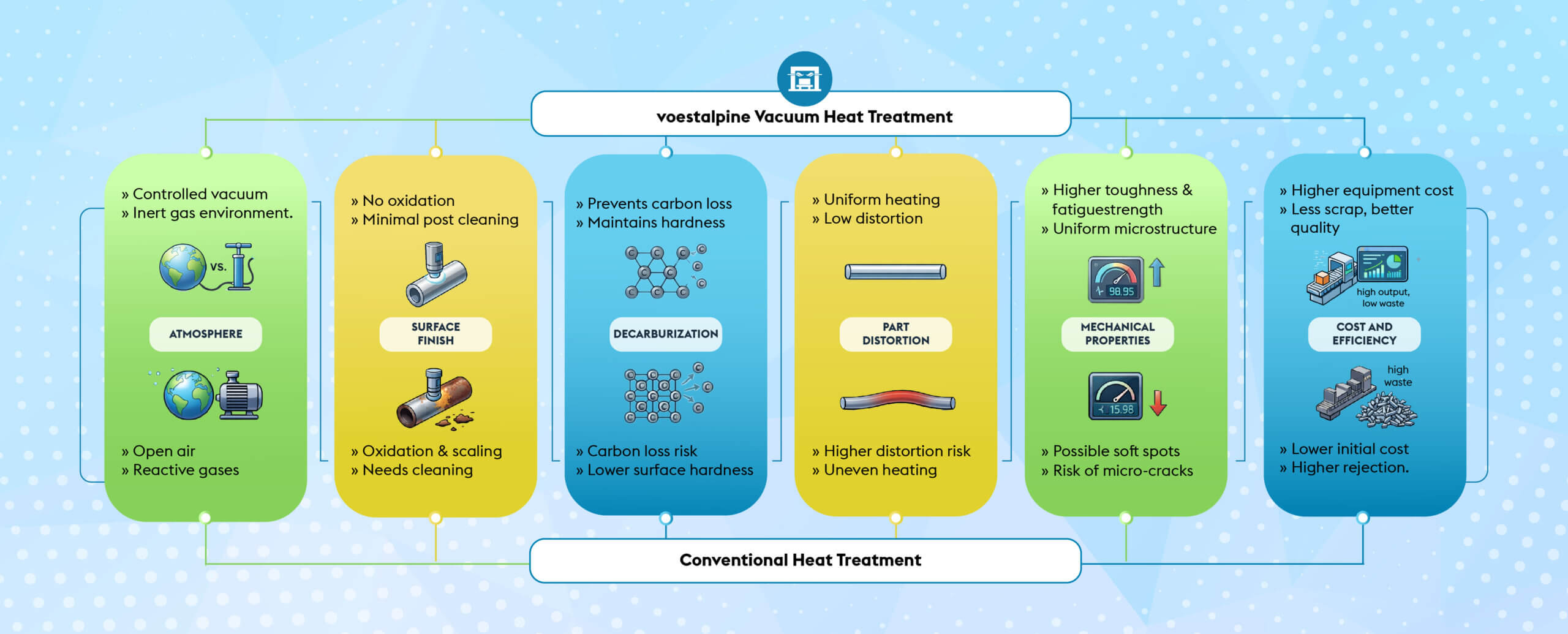
In this blog, we explore the technical advantages of vacuum heat treatment and compare it with traditional conventional heat treatment across key parameters such as atmosphere control, surface finish, decarburization, part distortion, mechanical properties, and overall cost efficiency.
1. Atmosphere Control: The Foundation of Quality
Atmosphere plays a defining role in heat treatment, influencing oxidation, scaling, surface contamination, and dimensional stability.
Vacuum Heat Treatment
Vacuum heat treatment takes place in a controlled vacuum or inert gas environment. This eliminates reactive elements—oxygen, nitrogen, and water vapor—that can compromise the metal’s surface and microstructure.
Advantages:
- Extremely clean environment
- No oxidation or scaling
- Consistent repeatability across batches
Conventional Heat Treatment
Conventional furnaces operate in open air or controlled atmospheres with active gases such as CO, CO₂, or endothermic gas mixtures. These gases can interact with the steel surface, often unpredictably.
Limitations:
- Oxidation and scaling are common
- Surface contamination and discoloration
- Requires monitoring of atmospheric composition
Conclusion: Vacuum technology ensures a stable and contamination‑free environment, leading to superior surface quality and more consistent results.
2. Surface Finish: Eliminating the Need for Post‑Treatment Cleaning
Surface finish is particularly important for precision tooling, molds, dies, and high‑performance components where dimensional accuracy is crucial.
Vacuum Heat Treatment
In vacuum furnaces, the absence of oxygen means no oxidation, no scaling, and minimal discoloration. In most cases, components require little or no post‑treatment cleaning.
This translates directly to:
- Reduced machining or polishing time
- Better dimensional accuracy
- Faster overall production cycles
Conventional Heat Treatment
In conventional heat treatment, high temperatures are achieved in oxygen‑rich environments. As a result, secondary processes like pickling, sandblasting, or grinding become necessary
This results to:
- Surface scaling
- Oxide formation
- Discoloration
Conclusion: Convectional heat treatment leads to extra labor, added consumable cost, and potential loss of dimensional accuracy.
3. Decarburization: Preserving Surface Hardness
Decarburization is one of the major concerns with conventional heat treatment, especially in tool steels and engineering components where surface hardness is crucial.
Vacuum Heat Treatment
Vacuum environments prevent carbon loss from the surface.
This ensures:
- Full preservation of surface hardness
- Improved wear resistance
- Stable microstructure from surface to core
Conventional Heat Treatment
Exposure to oxygen and active gases leads to:
- Carbon loss
- Soft surface zones
- Lower wear resistance
- Increased risk of quench‑soft spots
Conclusion: In conventional heat treatment, the presence of decarburized layers means additional material removal—again adding cost and increasing wastage compared to vacuum heat treatment.
4. Part Distortion: Achieving Dimensional Stability
Distortion control is a key challenge when treating high‑precision parts.
Vacuum Heat Treatment
Vacuum furnaces provide uniform heating and controlled gas quenching, often using high‑pressure nitrogen or argon.
This results in:
- Significantly lower distortion
- Higher dimensional accuracy
- Lower risk of cracking
Conventional Heat Treatment
In conventional heat treatment, uneven heating and harsh quenching mediums (like oil or water) cause:
- High distortion
- Increased residual stresses
- Increased rate of scrapped parts
- Higher re‑machining costs
Conclusion: Vacuum technology, with its controlled cooling cycles, is far more reliable for complex geometries and tight tolerances.
5. Mechanical Properties: Stronger, Tougher, More Consistent
The ultimate goal of heat treatment is to enhance mechanical performance.
Vacuum Heat Treatment
Vacuum technology ensures:
- Improved toughness and fatigue strength
- Better plasticity
- Degassing and purification of the metal
- Uniform and refined microstructure
Conventional Heat Treatment
While capable of achieving good hardness, conventional methods suffer from:
- Inconsistencies in microstructure
- Soft spots and micro‑cracks
- Higher variability between batches
Conclusion: Vacuum furnaces, by contrast, produce more predictable and repeatable results. The result is high reliability and consistent mechanical performance across the entire treated batch.
6. Cost and Efficiency: Long‑Term Gains
Vacuum Heat Treatment
- Reduced labor due to minimal cleaning
- Lower rate of part rejection
- Less scrap and re‑work
- Higher quality output suitable for demanding industries
Conventional Heat Treatment
- Higher labor costs
- Greater energy consumption
Conclusion: While vacuum systems require higher initial investment, they provide long‑term economic benefits.
Vacuum Heat Treatment Is the Future
voestalpine’s Vacuum Heat Treatment represents a major leap forward in metallurgical technology. It ensures cleaner surfaces, precise dimensional control, superior mechanical properties, and significantly reduced part rejection. For industries that demand reliability—tooling, automotive, aerospace, energy, and precision engineering—vacuum technology isn’t just an upgrade; it’s a necessity.
By choosing voestalpine’s state‑of‑the‑art vacuum heat treatment, manufacturers benefit from:
- Higher quality
- Improved durability
- Lower long‑term costs
- More consistent performance
As industries continue to evolve, vacuum heat treatment stands out as the most advanced, precise, and efficient method for achieving high‑performance steel characteristics.