Voltar à perspetiva geral

The Axle Counting Duo – AXM module and UniAS wheel sensor

2026-05-18 | 

In railway signaling, demands for safety, availability, and strong data collection are growing. Today, train detection systems must not only operate reliably, but also be flexible, low-maintenance, and resistant to environmental conditions. One solution that meets these requirements is the axle counting duo consisting of the AXM module and the UniAS wheel sensor. Together, they form the operational heart of the UniAC[2] axle counting system from voestalpine Railway Systems.

The UniAS Wheel Sensor: Precision on Track

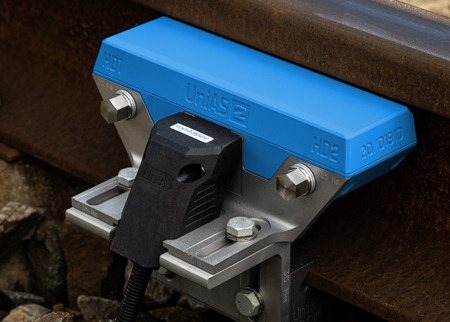
The UniAS wheel sensor plays a central role directly on the track: the reliable detection of train wheels. Accuracy and robustness are crucial here. The UniAS sensor is IP68-certified, making it resistant to dust and immersion in water. It also operates seamlessly across extreme temperatures, from –40 °C to +85 °C, ensuring dependable wheel detection under snow, heat, or heavy rain. 

Another advantage is that the sensor offers high immunity to electromagnetic interference. Thanks to intelligent evaluation algorithms, it is compatible with a wide range of rolling stock - from light rail to high-speed trains. UniAS also features a modular mounting clamp that fits most standard rail profiles, enabling easy on-site installation. This eliminates the need for engineering and civil work.  

In short: UniAS is not just a sensor — it is a rugged, adaptable, safety certified detection solution engineered for high availability.

AXM Module: The Art of Axle Counting

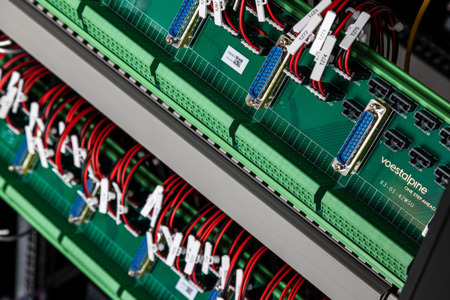
While the UniAS wheel sensor captures the data, the AXM module handles central processing. It acts as the “brain” located in the indoor equipment spaces - responsible for secure evaluation, counting, communication, and system supervision.  

UniAC[2] uses a single multipurpose module type, the AXM, which can be configured to perform all required functions of the axle counting system, depending on the deployment scenario. This reduces spare parts, simplifies logistics, standardizes training, and cuts lifecycle support costs. 

Each AXM module can handle up to four counting sections, supporting both centralized and decentralized designs. This enables engineers to design efficient layouts, whether the installation spans a small station or extensive rail networks. In addition, AXM supports multiple safe interface methods — including protocol-based communication, optocoupler, or relay. This, in turn, enables seamless integration with interlockings, level crossing systems, and CTC/ETCS components. 

Why they excel together: System-level synergy

The full potential of the UniAC[2] axle counting system is only realized through the interaction of these two technologies. The AXM module, together with the UniAS wheel sensor, offers the following advantages: 

  • SIL4-certified train detection 

Both AXM and UniAS operate within a system certified to CENELEC SIL4 — the highest functional safety level for railway signaling. This ensures dependable, faulttolerant operation even in complex network conditions.  

  • Reduced trackside electronics 

The system architecture eliminates unnecessary outdoor electronics and transfers critical processing indoors, reducing field failures and improving long-term reliability.  

  • High EMC resistance 

The 20-mA current loop interface between UniAS sensors and the AXM module makes the system highly resistant to electromagnetic interference. A crucial factor — especially in electric railways and heavy-haul environments. 

  • Plug-and-Play installation 

The combination supports a plug-and-play configuration, which reduces site setup time and enables fast commissioning. 

  • Future-ready digital architecture 

Both components are part of a platform designed for future integrations, including the EULYNX SCI-TDS safe communication protocol and the EULYNX SMI, SDI, and SSI interfaces for diagnostics, maintenance, and secure operation. 

From the reliability of the UniAS wheel sensor on the track to the flexible and intelligent design of the AXM module  the interaction between these two components sets new standards in axle counting and meets the key requirements of modern systems. Namely: high availability, low maintenance, cybersecurity by design, operational flexibility, and a modular, scalable architecture.