Cold-drawn bar - a new product segment
Wire Insights podcast episode 7
Listen now
Cold-drawn bar - a new product segment
Wire Insights podcast episode 7
Listen now
Deep dive into our core products cold heading steel grades and prestressing wire
Wire Insights Podcast Episode 6
Listen now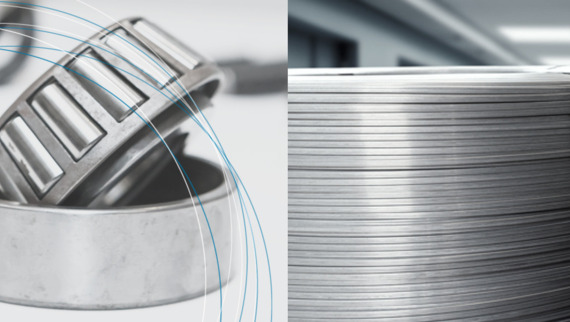
Deep dive into our core products bearing steel wire and shaped wire
Wire Insights Podcast Episode 5
Listen now
Sustainable excellence – premium quality with a low carbon footprint
Wire Insights Podcast Episode 4
Listen now
Beyond greenwashing - our path to transformation
Wire Insights Podcast Episode 3
Listen now
In Wire Insights we explore the latest developments and innovations at voestalpine Wire Technology – from pioneering materials to sustainable production processes. The podcast offers exclusive insights into current projects that are helping to transform the steel industry and shows how wire‑based innovations are shaping the world.
The wire industry is undergoing rapid change: new materials, advanced manufacturing technologies and sustainable solutions will define its future. Wire Insights provides expert knowledge and practical perspectives on these developments. Tune in and discover the technologies that will drive the wire industry forward. Be part of the future of wire innovation – knowledge starts here. 7 episodes are available.
Cold-drawn bar – our new product segment – is a solid long product shaped to final dimensions through controlled cold forming. This process ensures tight tolerances, high straightness, defined surface quality, and stable mechanical properties, making it suitable for automotive engineering, mechanical engineering, and energy applications.
The seventh episode of Wire Insights explains how cold-drawn bar differs from classic wire, which production steps determine its properties, and why a continuous process chain is essential. Holger Winter, Application Engineer, and Wolfgang Fasching, Process Technologist and Developer, provide insights into technical fundamentals, future developments, and potential applications.
(00:00 - 00:57)
Host: Welcome to Wire Insights, the podcast from voestalpine Wire Technology. Here we talk about developments, technologies, and solutions that shape our industry - from materials technology to industrial applications. You will gain in-depth insights into current projects and their practical significance.
This episode focuses on cold-drawn bar – a product that offers maximum precision and process reliability and opens new possibilities for demanding applications. What are its technical characteristics? What advantages does it offer for demanding applications? And how does voestalpine Wire Technology support its customers in material development and process optimization? Today, I will be talking to two experts from our company:
Welcome, Holger Winter, Application Engineer, and Wolfgang Fasching, Expert in Process Technology and Development.
(00:58 - 01:26)
Host: Mr. Winter, it's great to have you here. What are your responsibilities as an Application Engineer?
Winter: I look after customers from various industrial sectors and support them with technical issues and product development. My focus is on translating individual requirements for materials, processes, and component properties into practical solutions. I am also the central contact person for the introduction and application of our new product segment of cold-drawn bars.
(01:27 - 02:00)
Host: Thank you very much. Mr. Fasching, you are heavily involved in process technology and development. What does your daily work involve?
Fasching: I further develop our forming and testing processes to ensure stable and reproducible quality. This includes process analyses, the introduction of new technologies, and communication with application engineering and, if necessary, with customers in the case of special requirements. My many years of management experience help me to implement new processes and product ideas in a targeted manner.
(02:01 - 02:44)
Host: Mr. Winter, why is entering the cold-drawn bar segment more than just a product portfolio expansion for voestalpine Wire Technology?
Winter: Entering this segment is a strategic move. We are transferring our existing expertise in forming technology, materials development, and quality assurance to a new product, cold-drawn bar. This enables us to offer our customers an integrated portfolio from a single source. For companies, this means fewer interfaces, greater process reliability, and dependable quality - especially for safety-critical applications. Industries such as automotive, machine building, and energy, where precision and material performance are crucial, will benefit.
(02:45 - 04:31)
Host: Mr. Fasching, what distinguishes cold-drawn bar from conventional wire?
Fasching: The main difference lies in the geometry. Cold-drawn bar is a solid long product that is brought to its final dimensions by cold forming. It is used where the highest demands are placed on dimensional accuracy, straightness, and surface quality – for example, in precision components such as axles, shafts, or bearing components.
The product requirements also differ significantly. When drawing bars, the degree of forming, tool geometry, and straightening process must be precisely coordinated. This is the only way to reliably achieve the required tolerances, straightness, and surface quality of the bars.
Host: And how do you ensure these properties?
Fasching: Through a fully integrated process chain. We control every step - from steel production to hot forming, heat treatment, drawing, and final inspection. Every process is documented and traceable. For our customers, this means maximum transparency, high process reliability, and reproducible mechanical properties such as tensile strength or yield strength.
Host: What role does digital process monitoring play in this?
Fasching: A crucial one. We rely on inline measuring systems and digital data analysis to detect and correct deviations at an early stage. This enables us to ensure a high level of consistency from batch to batch – even with complex requirements.
In addition, we can specifically influence material properties. If certain strength or toughness values are required, we control the microstructure via process control. The combination of metallurgical expertise and reliable manufacturing makes our materials reliable and high-performance.
(04:32 - 06:08)
Host: Mr. Fasching, how do you support customers in the development of new materials? What is the path from the initial idea to the actual application?
Fasching: We accompany our customers throughout the entire development process – from the initial idea to series production. The process is structured, but extremely flexible thanks to our in-house research facilities such as Techmet, MetLab, and the Wire Tech Center. It usually starts with a specific requirement, such as higher strength, improved corrosion resistance, or optimized forming behavior.
We then develop a suitable alloy concept for cold-drawn bars, which we sample in our pilot plants and test under real conditions. At the same time, we check the scalability for industrial production. Only when all requirements have been met does implementation in series production take place.
In this way, we bridge the gap between research and practice and ensure that new materials not only work in theory but also perform reliably in application.
Host: What role do simulation methods or digital approaches play in the development of new alloys?
Fasching: Digital methods are now a central component of materials development. They enable us to understand and specifically influence complex relationships between alloy composition, process parameters, and material behavior.
With numerical models and digital twins, we can, for example, make predictions about microstructure development, forming behavior, or thermal stability - even before the first physical test takes place. This saves time and resources.
In combination with our pilot plants and real-world tests, this creates an efficient link between virtual pre-development and practical validation.
(06:09 - 06:33)
Host: Mr. Winter, how is this perceived from the customer's point of view – and how quickly can you respond to new market requirements?
Winter: Thanks to our flexible development structure and integrated production chain, we can often respond to new market requirements within a few weeks. Initial sampling is possible quickly because we combine research, pilot plants, and industrial scaling under one roof.
(06:34 - 07:59)
Host: What distinguishes your forming processes from classic drawing lines?
Fasching: We combine our wire drawing expertise with bar steel technology. This means precise control of the forming degrees, targeted intermediate treatments, and high-quality surface finishing - for example, through controlled phosphating or mechanical smoothing. In contrast to conventional drawing lines, which often use standardized processes, our processes enable flexible and application-specific adaptation – for maximum dimensional accuracy and surface quality.
The dimensional accuracy and surface quality when drawing bars depend largely on parameters such as drawing speed, lubrication, tool geometry, and temperature control.
Host: How do you ensure that the surface quality is maintained even at high degrees of deformation?
Fasching: To guarantee surface quality, we rely on optimized tool coatings, controlled friction conditions, and a precisely coordinated process. We use inline measuring systems, adaptive control systems, and digital monitoring, precisely coordinate the drawing parameters, and carry out process-accompanying tests such as eddy current testing. The drawing processes for cold-drawn bars are designed in such a way that the surface quality is reliably maintained even at high degrees of deformation. A uniform, clean surface reduces the effort required in subsequent process steps at the customer's site.
(08:00 - 09:46)
Host: Mr. Winter, how do you help customers find the right material?
Winter: We work together to analyze the mechanical, thermal, and tribological requirements and recommend materials that are technically and economically optimal. We draw on a portfolio of over 400 steel grades – from standard qualities to highly specialized alloys.
Host: How do you deal with conflicting objectives – for example, between high strength and good machinability?
Winter: This is precisely where our material development comes in. We work with multi-parameter optimization approaches to reconcile both requirements, for example through microalloys or targeted heat treatment.
Host: What services do you offer beyond the product itself?
Winter: We see ourselves not only as a materials supplier, but also as a global development partner. In addition to classic materials consulting, we offer co-engineering from the idea to series production of cold-drawn bars, digital simulation support, testing concepts, and customized logistics solutions—such as just-in-time delivery, packaging concepts, and traceability services. Our goal is to maximize customer benefit holistically.
Host: What role does sustainability play in the production of cold-drawn bars?
Winter: A central one. When selecting materials, we already pay attention to resource-saving alloy concepts and recyclability. In the production of cold-drawn bars, we rely on energy-efficient processes, optimized lubrication systems, and forming with as little loss as possible. Digital approaches such as simulations and inline measuring systems enable precise process control, which not only ensures quality but also saves energy and raw materials.
(09:47 - 11:04)
Host: Mr. Fasching, how do you integrate customer feedback into further development?
Fasching: Customer feedback is an essential part of our continuous product and process optimization. We consider every piece of feedback - whether from application, quality assurance, or logistics - to be a valuable stimulus. We analyze this information and incorporate it directly into the adaptation of alloy concepts, manufacturing parameters, and testing methods. Through regular technical reviews, joint development projects, and open communication channels, we create a partnership-based foundation on which innovation and quality grow together.
Host: What are the next steps for the cold-drawn bar product segment?
Fasching: We are working on new alloy concepts, continuously optimizing our drawing processes, and evaluating innovative testing methods - such as AI-supported inline quality control.
Host: Thank you very much, Mr. Winter and Mr. Fasching, for the valuable insights into cold-drawn bar and the processes behind it.
If you would like to learn more, visit the voestalpine Wire Technology website or contact them directly. Thank you for listening - and see you next time on Wire Insights.
The sixth episode of Wire Insights highlights two key product areas: cold heading wire and prestressing steel wire - essential for applications requiring maximum precision and strength, from automotive components to modern construction.
In this episode, Uwe Tertinek, Application Engineer with a background in materials science, explains the role of cold heading steels in producing complex and durable parts such as screws and fasteners. Dieter Kalcher, Team Leader for Sales and Customer Relations, provides insights into prestressing steel wire, a crucial material for load‑bearing structures in construction.
(00:00 - 01:25)
Welcome to Wire Insights, the podcast of the latest developments, innovations and trends at voestalpine Wire Technology. From cutting-edge materials to sustainable production processes. Experience exciting insights into current projects that are revolutionizing the industry and find out how innovations made of wire are changing the world.
Whether you are a technology enthusiast, an industry professional or just curious about the future, this podcast is for you. Tune in and join us. Welcome back to Wire Insights, your go-to podcast for deep dives into the world of voestalpine Wire Technology, innovation and engineering excellence.
In today's episode Wire Excellence, a deep dive into our core products of cold heading steel grades and prestressing wire. We are exploring two highly specialized and impactful topics. These materials are essential in applications where strength, precision and reliability are non-negotiable, from automotive components to large-scale infrastructure projects.
To help us understanding more about these fascinating materials, we are joined by two experts from voestalpine Wire Technology.
(01:20 - 01:55)
First, a warm welcome to our guests, Mr. Uwe Tertinek. It's great to have you with us. Could you please introduce yourself and tell us about your background and your role?
Hello and thanks for inviting me. I'm really happy to be here. So, as an Application Engineer, I'm responsible for supporting our customers with any technical questions they might have.
I studied material science at the Montanuniversität in Leoben and joined the company back in 2012. I spent six years working in research and development before switching to Application Engineering in 2018.
(01:56 - 01:25)
And also joining us today is Mr. Dieter Kalcher. Welcome to Wire Insights. We'd like to hear about your journey and what you do at voestalpine Wire Technology.
Also a warm welcome from my side. I started as an apprentice at our site in Bruck an der Mur over 35 years ago. After many interesting tasks, some of which were also outside of Bruck, I had the opportunity three years ago to take on the team leadership for sales and application engineering, also for our construction products and thus also for prestressing steel wire.
(02:33 - 03:48)
Mr. Tertinek, what areas of application are there for cold heading steels?
Cold heading steels are one of the most important product groups for our business unit. They are used everywhere in our daily life where precise, durable and often complex shaped components are required. Such as different kind of screws, fasteners and anchors. So typical application areas include industries like automotive, mechanical engineering, household appliances, so-called white goods, the energy sector and last but not least the construction industry.
In general, cold heading steels are used wherever good surface quality and high formability are required. Additionally, their strength increases through cold forming which is particularly relevant for the final component and its intended use. Beside the classic and well known steel grades, we also have so-called AFP grades in our standard product portfolio.
AFP stands for Advanced Ferritic-Perlitic. Those micro-alloyed steels do not require heat treatment to achieve desired properties. So they are ideal for high strength parts that are typically quenched and tempered after forming.
(03:49 - 05:14)
What properties make cold heading steels particularly suitable for the manufacture of precision components? There are quite a few very important requirements and properties of cold heading steels. First, they have a high cold formability. They are able to undergo extensive plastic deformation without cracks or fractures.
This requires high purity and a uniform microstructure. Especially important for multi-stage forging processes that are widely used in the industry is a good toughness. The material must remain ductile and not become brittle and needs uniform mechanical properties.
Very important as well is a good surface quality. A uniform smooth surface is necessary as even minor surface defects can lead to cracks during forming and thus to material failure. Steels are often supplied with phosphate soap and or polymer coatings to reduce friction during forming steps, which also positively affects tool life.
Due to customer production processes, cold heading steels must meet very tight tolerances and high shape accuracy. So in short, cold heading steels must offer a perfect balance between good formability and specifically adjusted high strength, while also ensuring excellent surface quality and dimensional accuracy.
(05:15 - 07:45)
How does the production process for cold heading steels differ from other types of steel and what advantages are there in terms of production within voestalpine Wire Technology? Special requirements in the production of cold forming steels include for example a very precise chemical composition with narrow limits.
Tight tolerances for elements like carbon, manganese, sulfur and phosphorus are important for good formability. Also important is a very low level of non-metallic inclusions, as inclusions can cause cracks during cold forming. The wire rolling process itself involves precise temperature control and targeted cooling to produce a fine-grained homogeneous microstructure.
Here I also want to refer to the podcast with Mr. Kienreich, where he explains the benefits of thermomechanical rolling in detail. At our site here in St. Peter-Freienstein we perform so-called GKZ annealing, meaning annealing for spheroidized cementite. This reduces wire strength and improves formability.
When it comes to the advantages of cold heading steels we deliver as voestalpine Wire Technology, I want to point out especially our high purity steel quality. Our raw material supplier voestalpine Stahl Donowitz produces steel with the state-of-the-art secondary metallurgy. This ensures high purity and thus excellent formability.
The wire rolling mill in St. Peter-Freienstein can deliver very tight tolerances across a wide range of wire diameters, the basis for a trouble-free process in forming machines. There is an ongoing R&D project aiming to launch a phosphate-free alternative to traditional phosphating. This saves the customer a cleaning step and improves the CO2 footprint of the product.
We as voestalpine Wire Technology offer a fully integrated process chain from the steel mill to the drawn wire, everything from a single source. This minimizes potential errors and ensures consistent quality. Our unique R&D infrastructure with the Techmet and the Wire Technikum provides the basis for continuous development and product quality improvements.
And of course we focus heavily on CO2 reduced production, for example the green steel initiative at voestalpine. At the end of the day, this makes cold-heading steel greener.
(07:46 - 09:44)
Before we move on a big thank you to Uwe Tertinek for the valuable insights and perspectives you've shared with us today. Now let's turn our attention to a topic that's fundamental to structural engineering.
Pre-stressing steel wire. Dieter Kalcher is here with us and he brings a wealth of experience in this area. Mr. Kalcher could you walk us through what makes prestressing wire so essential? What role does pre-stressing steel wire play in the modern construction industry and what advantages does it offer?
Pre-stressing steel puts the concrete in the structure under pressure, thus limiting the tensile stresses that occur and therefore the cracks in the concrete. Concrete is generally very resistant to compression but is more sensitive to tensile stresses. The pre-stressing steel is also responsible for absorbing dynamic stresses, for example in concrete slippers.
Okay, how is the quality and strength of pre-stressing steel wire ensured? The quality of pre-stressing steel wire begins with the use of qualified high carbon wire rod as the starting material. The tensile strength of the pre-stressing steel wire produced is determined by the diameter of the wire rod and the individual cold deformation steps in the drawing and stabilizing process. In addition to the high tensile strength with correspondingly good ductility, the stabilization process also achieves very low relaxation of the pre-stressing steel wire.
This means that the prestressing steel wire can permanently maintain the pre-stressing force applied in the concrete of structure. And the stabilization process also ensures that the wire is very straight when in use.
(09:45 - 10:41)
What challenges and trends do you see in the future for the use of pre-stressing steel wire and what solutions does voestalpine Wire Technology offer?
Prestressing steel wires are always divided into tensile classes according to existing standards and approvals.
One noticeable trend is certainly the development towards higher tensile strength in the same diameter range. Furthermore, we are also noticing the trend from classic concrete construction. So this is prestressing steel wire anchored in concrete towards the use of pre-stressing steel wire in wind energy.
Prestressing of concrete wind towers with external pre-stressing. In this case, the pre-stressing steel wire is located outside the concrete as an external tendon to tension the individual concrete segments of the tower together.
(10:42 - 11:03)
Thank you for the comprehensive insights. It's always enriching to dive so deeply into your areas and your expertise. And that brings us to the end of this episode of Wire Insights with Uwe Tertenek and Dieter Kalcher. Thank you to our guests for joining us today.
It's been a pleasure hearing your thoughts and experiences.
(11:04 - 11:37)
Before we wrap up, we'd like to hear what's currently keeping you busy. Any exciting projects or ideas you're working on that you'd like to share with our listeners? Mr. Kalcher first.
Of course, I think we have a very interesting project. We are currently working on a large stay cable bridge project in Taiwan. Designed by Zaha Hadid Architects and we are supplying the strand products for this project.
I would also like to take this opportunity to thank the entire team that makes it possible for us to realize such large projects.
(11:38 - 12:12)
And what projects are you currently working on, Mr. Tertenek?
As an Application Engineer, I'm in contact with many customers from various industries. But what is important for all of them and for our future in general is resource saving and CO2 reduced production throughout the entire process.
Therefore, the upcoming conversion of our steel base to EAF is of course a topic that accompanies me every day. Thank you. That wraps up this episode of Wire Insights with Uwe Tertinek and Dieter Kalcher.
(12:13 - 12:37)
A big thank you to our today's guests for sharing your expertise and perspectives. Your insights truly sparked some powerful conversations. And to our listeners, thanks for tuning in.
We've got something exciting lined up for next time. So stay curious and stay connected. Until then, take care and keep exploring the world of voestalpine Wire Technology.
The fifth episode of Wire Insights highlights two key product areas of voestalpine Wire Technology: roller bearing steel wire and shaped wire.
Experts Stefan Monschein and Bernadette Doppelhofer provide insights into technological innovations, quality strategies, and current developments. They explain how voestalpine Wire Technology achieves exceptional precision, resilience, and sustainability through advanced facilities, integrated processes, and forward‑looking research.
Whether high‑strength roller bearing wire or complex profile wire shapes - voestalpine Wire Technology is shaping the wire industry’s future with expertise and innovation.
(00:00 - 01:25)
Welcome to Wire Insights, the podcast of the latest developments, innovations and trends at voestalpine Wire Technology. From cutting-edge materials to sustainable production processes. Experience exciting insights into current projects that are revolutionizing the industry and find out how innovations made of wire are changing the world.
Whether you are a technology enthusiast, an industry professional or just curious about the future, this podcast is for you. Tune in and join us. Welcome to a new episode of Wire Insights.
In today's episode, wire excellence, a deep dive into our core products of bearing steel wire and shaped wire. We explore the innovation, precision and performance behind two of voestalpine Wire Technology's most essential product lines. Join us as we uncover what makes these wires the backbone of high-performance applications around the world.
To explore this topic, we are joined by two insightful guests who will share their expertise on the technology production and challenges surrounding these products. Get ready for interesting facts, practical insights and maybe even a few surprises from the world of wire. Now, I'm very pleased to welcome our first guest today, Stefan Monschein.
(01:26 - 01:39)
Mr. Monschein, it's great to have you with us on Wire Insights. Before we dive into the technical details, could you introduce yourself and tell us about your background and career journey at voestalpine Wire Technology?
(01:40 - 02:42)
Hello, I'm working at voestalpine Wire Austria since 2022 as an application engineer. In this role, I support various customers in the automotive industry, including those in the bearing industry, focusing on technical support, product development and ensuring the high quality standards for steel wire products.
Before joining voestalpine Wire Austria, I studied material science at Montan Universität Leoben, where I finished my master's degree in 2019. And after that, I worked as a PhD researcher for three years and completed my PhD in 2022. So my PhD work already was part of a joint research project with voestalpine Wire Technology's R&D department and focused on the development of micro-alloyed steels for high performance applications like chains and screws. So you could say that I was well prepared for my future role within voestalpine Wire Technology during my university career.
(02:43 - 04:46)
Okay, can you give us an overview of the key applications of ball bearing wires and roller bearing steel wires and why they are so crucial for these applications? Okay, so when we think about motion, so whether it's in a car, a wind turbine, a robot arm or even a household appliance, there's always one common element that keeps things moving smoothly and this is a bearing. So wherever something rotates, rolls or turns, there's almost always a bearing involved.
And inside these bearings you will find high precision components made from bearing steel wire. And the best known of these steel grades for instance is 100 chromium 6. So in a way, bearing wire is the silent backbone of motion in the automotive industry and industrial machinery and beyond. Ball bearing wires and roller bearing steel wires are used in highly demanding mechanical applications where dynamic loads, high rotational speeds and long service life are expected.
So these wires are crucial because the final bearing products must meet extremely high standards for fatigue resistance, dimensional precision and especially wear resistance. And all of this is only possible if the starting material, the wire, is of the highest metallurgical and surface quality. So we at voestalpine Wire Technology have traditionally been a strong supplier for taper and cylindrical bearing applications.
However ball bearing applications so far have have long been dominated by block casting producers. And this changed with the commissioning of our new continuous casting plant with the jumbo format which allowed us to enter this high-end segment of ball bearing applications as well. And thanks to advanced features like electromagnetic steering and soft reduction this plant gives us the ability to produce a clean and highly homogeneous microstructure which is essential for meeting the stringent inclusion and segregation requirements in ball bearing steels.
(04:47 - 06:26)
How does voestalpine Wire Technology ensure that there are wires for ball bearings and roller bearings meet the highest quality standards? So in addition to the before mentioned points with the continuous casting technology for ball bearing wire specifically we developed a unique heat treatment route to optimize the microstructure. And on top of that we also apply non-destructive testing methods like ultrasonic and eddy current inspection to guarantee defect-free surfaces and internal structures. So thanks to this comprehensive quality strategy we became the first European supplier qualified for ball bearing applications from the continuous casting route which is a major milestone for our company and also our customers.
Another big advantage we have is that voestalpine Wire Technology controls the entire value chain in-house. So that includes the steel making at voestalpine Stahl Donauwitz, the wire rod production at voestalpine Wire Rod Austria, the wire drawing at voestalpine Wire Austria and also our R&D department. So all located close together within our company network and also geographically.
So this allows us for fast feedback loops, tight process control and also continuous improvements. And our corporate values, quality, sustainability, innovation and flexibility are embedded in every step of our process and I believe that's one of the key reasons for our success in such a demanding segment like ball bearings and bearing applications.
(06:27 - 08:28)
Okay, what future trends and developments do you see in the field of bearing technology? The bearing industry is of course also evolving continuously.
One clear trend is the move toward a zero defect philosophy. So we see that what used to be acceptable defect rates are no longer tolerated especially in high performance applications. This puts even more pressure on material producers to ensure this high quality from the very beginning.
At the same time sustainability is becoming increasingly important. So customers and end users are pushing the whole market for lower CO2 emissions across the entire supply chain and this aligns well with our plans. So from 2027 onwards voestalpine will introduce an electric arc furnace as part of our decarbonization strategy and this will allow us to produce high quality bearing steel with a significantly lower carbon footprint.
I think another important development is digitalization and predictive quality control. By combining real-time process monitoring with advanced AI analytics we aim to monitor deviations before they occur and this will also be critical in meeting the rising expectations of our customers in terms of quality and consistency. And finally I would say collaboration will be more important than ever.
So bearing manufacturers increasingly want material suppliers who can support them not just with high quality products but also with know-how, joint development projects and rapid responses to changing requirements. So in summary high performance bearing wires require excellence in every production step from steel making to final inspection in the drawing facility. We at voestalpine Wire Technology have the big advantage to control the whole process chain in-house and we are very proud to be shaping the future of this field together with our partners and customers.
(08:29 - 08:38)
Thank you so much for sharing your insights and giving us a great overview of your work and experience at voestalpine Wire Technology.
(08:39 - 08:54)
Now I'm delighted to welcome our second guest Bernadette Doppelhofer. Bernadette it's a pleasure to have you here. Could you also take a moment to introduce yourself and share a bit about your role and your journey at voestalpine Wire Technology.
(08:55 - 09:26)
Yeah hello Dieter, thank you to be here. Yeah unbelievable I have my 10 year anniversary now here at voestalpine.
I started here in St. Peter at Wire Rod Mill for process engineering and then my journey goes to another direction to the sales department and at the moment I'm working in Bruck in the voestalpine Wire Austria and support there as a kind of hybrid application and sales manager.
(09:27 - 11:02)
What technological innovations has voestalpine Wire Technology introduced in recent years in the field of profile wire production? So in recent years voestalpine Wire Technology has been focusing on making our profile wire producing even better through technology. Two key developments really stand out.
The most important one is that we have commissioned a new cold profile rolling machine our KPWA as we call it in Bruck. This isn't just a simple upgrade it's a significant expansion of our capabilities. This new facility allows us to produce wire across sections starting from a much smaller size of about two square millimeters. What's particularly exciting is the special height to width ratio this new line can achieve opening up possibilities for entirely new applications of our profile wires. Beyond just size this new machine also brings about improvements in the surface quality of the wire and very tight tolerances as well. This is crucial because of our customers demand.
Finally this boosts our production capacity and significantly expands our portfolio in Bruck. We are a big player of providing complex profiles and with this new system we will continue to discover new areas of applications in profile wire technology.
(11:03 - 11:54)
How does voestalpine ensure that their wires meet the highest quality standards? Quality is absolutely paramount for us at voestalpine Wire Technology.
It starts with the careful selection of high grade raw materials. Then throughout the entire production process from voestalpine Donowitz from the steel plant through the wire rod mill we have stringent quality control measures in place including automated checks and manual inspections by our expertised technicians. We fulfill strict international standards and certifications.
Beyond that we believe in continuous improvement. We constantly analyze and processes and customer feedback to identify areas where we can further enhance our quality.
(11:55 - 14:50)
What future trends and developments do you see in the field of profile wire technology? All right let's dive into three future trends what I want to mention.
Surface defect for zero failure strategy and higher strength and at least weight saving and downsizing. A crucial trend is the growing emphasis on surface detection for zero failure strategy. Our customers rightly demand the highest level of reliability and this means the requirements are increasingly moving in the direction of defect-free wire.
We are investing heavily in advanced sensor technologies and inline inspection systems that can detect even the smallest surface failures in real time. This allows us to identify and eliminate any potential issues working towards a zero failure approach. Another trend is that the demand for higher strength in profile wire continues to rise.
Often this needs to be achieved without the added complexity and cost of for example after treatment. This requires ongoing advancements in material science and or cold forming processes to create alloys and shaping techniques that deliver exceptional strength directly. Finally we are observing a clear trend towards downsizing as customers require ever smaller and more complex wire profiles for their compact applications.
This downsizing often goes hand in hand with the demand for weight saving particularly in industrials like automotive or aerospace where every gram counts. To meet these challenges we are constantly innovating our production techniques to achieve these complex geometries with tighter tolerances and as I mentioned at the beginning our latest machine the cold profile rolling machine hitting the tooth of time. It's crucial to understand the realizing these advancements.
Producing ever smaller and more challenging profiles with increasingly demanding properties is only possible through the deep experience and expertises of our engineering team. Our ability to constantly push the boundaries of profile wire technology relies heavily on the knowledge and dedication of our engineers. They are driving by a shared goal to provide our customers with the absolute best possibility solution for the specific needs they want.
This is our more or less customer-centric mindset and yes we are really good team.
(14:51 - 15:29)
Before we wrap up we'd like to hear what you're currently working on. Could you each give us a quick insight into the projects or developments that are keeping you busy right now, Ms. Doppelhofer? Yeah at the moment a major challenge is the commissioning of very small complex profiles with extremely high strengths.
We are really pushing ourselves at the moment to the to the limits. Sometimes we are with success and sometimes we fail. Then we go back to the start and try again with another idea.
But most of the time we are successful.
(15:30 - 16:20)
Thank you. Mr. Monschein, what keeps you busy right now? So first of all also thank you from my side for having the chance to to speak here today.
In my role as an application engineer I'm not only involved in the field of bearing steels but also support a wide range of automotive customers who use our cold trading grades. Currently I'm engaged in several exciting internal optimization projects as well as numerous customer projects and maybe one highlight I would like to mention is a pioneering project where we at voestalpine Wire Austria are producing drawn wire with diameters below one millimeter for the first time with the the big aim to establish a foothold in the indian market. So quite challenging but also very exciting times.
(16:21 - 16:45)
Thank you both for these fascinating insights and for taking the time to share your expertise with us today. It's been a real pleasure having you on Wire Insights. And to our listeners thank you for tuning in.
If you enjoyed this episode don't forget to share it with colleagues or friends. Until next time stay curious and keep exploring the world of wire technology.
(0:00 - 1:25)
Welcome to Wire Insights, the podcast of the latest developments, innovations and trends at voestalpine Wire Technology. From cutting-edge materials to sustainable production processes. Experience exciting insights into current projects that are revolutionizing the industry and find out how innovations made of wire are changing the world.
Whether you are a technology enthusiast, an industry professional or just curious about the future, this podcast is for you. Tune in and join us. Mr. Galler and Mr. Gasser, thank you for accepting our invitation and welcome to the new episode of the voestalpine Wire Technology podcast.
My name is Dieter Danko and today we dive into an exciting and forward-looking topic. Sustainable excellence, premium quality with a low CO2 footprint. We will discuss how voestalpine Wire Technology utilizes innovative technologies and sustainable processes to ensure the highest quality standards while minimizing the ecological footprint.
Mr. Galler and Mr. Gasser, before we delve into the technical topics, we would like to ask you to briefly outline the milestones of your professional career, Mr. Galler.
(1:26 - 3:35)
Gladly, thank you very much. The first milestone of my professional career was 20 years ago when I decided to move to Austria from the USA to get my PhD at the TU Graz in material science and engineering.
I even wrote my dissertation for voestalpine Linz on resistant spot welding of automotive sheet steel, and I had the chance to learn the voestalpine working culture for the first time. After my first employments at Material Center Leoben and Magna Powertrain, I started my voestalpine career in 2017 in research and development and innovation and product management in the area of material and product development. One of my first project leads was a cooperation with Material Center Leoben, the mining university of Leoben, as well as a key customer in the automobile industry and the title was development of new material concepts for thermal mechanically processed cold heading wires.
There was such good cooperation with this customer that we did further research on this topic and registered our first patent in the area of high strength and hydrogen resistant fasteners at the end of 2020. In 2022, I was nominated for the expert career path, and I received my expert title in material development for cold heading grade steels. Also in 2022, I had the opportunity to take and finish an educational program from the Deutsche Schraubenverband or the German screw organization and I received a new title Screw Specialist Engineer DSV and recently in 2025 the patent was accepted and now we are involved in the serial implementation phase as well as the marketing of the new product.
And now I'm currently involved in numerous R&D projects spanning across voestalpine divisions together with universities and research institutes as well as interdepartmental projects with application engineering, production, sales and finally with key development customers with the aim to ensure a seamless transition to EAF steel production in 2027. Thank you.
(3:36 - 4:46)
Mr. Gasser, what are the milestones of your career? Hello Dieter and thank you for having us today. My name is Stefan Gasser. I started working for voestalpine Wire Technology approximately 12 years ago after I finished my education as a mining and logistics engineer. For eight years, I collected experiences in the quality department before I got the chance to switch to the application engineering in 2021.
My job now is basically being the technical key account to the customer. We assess new projects, travel to the customers to see what they produce out of our wire and assist them with possible problems and also act as the connector to the steel mill. Last summer, I had the chance to become the manager of a project that will establish an optimized steel grade portfolio for our future and in the current green tech steel program, I'm responsible for coordinating all the trial productions and since this is the largest climate protection measure of Austria, I'm more than honored that I can make a contribution to it.
(4:47 - 7:05)
What specific measures is voestalpine Wire Technology taking to produce premium wire solutions with a low CO2 footprint? voestalpine Wire Technology offers a large portfolio of premium wire products to supply our customers in different market fields. Since we are quite automotive and energy focused, we are of course part of the current energy transition and confronted with a lot of customer demands regarding CO2 reduced steel. For this reason, voestalpine decided to build electric arc furnaces on their production sites and one of them is already under construction at voestalpine Stahl Donawitz in Leoben.
The existing blast furnaces that produce considerable amounts of CO2 will be shut down step by step in the next years, starting with the first one in 2027. To avoid green washing, it's also important of course to use sustainable electricity for the new arc furnaces. That's why we are also setting up an infrastructure accordingly and if you want to know about this, please listen to our previous podcast that focuses on the green transformation and the regarding project Roadmap to Zero.
Besides these activities at the steel mill, we also have to reconsider our existing steel grade and product portfolio. Simply explained, producing steel with the electric arc furnace method means using mainly scrap instead of smelted iron ores as a pre-material. According to the current state of technology, there are no environmentally friendly alternatives to produce new steel from iron ore in the required amount.
And since most European steel producers switch to the EAF route in the near future, high quality steel scrap will be definitely a sought-after product on the market. No one can really predict how the availability of scrap in different quality classes will be and how high the content of so-called trace elements that are brought into the steel from scrap impurities like copper cables will be. And this is a very important question that we have been investigating to prepare for the transformation.
(7:06 - 9:06)
Okay, Mr. Galler, how does the company ensure that its high product quality is maintained despite transitioning to more environmentally friendly production methods? For more than four years, we've been investigating within the framework of various R&D projects the most important questions regarding the EAF transformation. These questions are number one, what is the influence of increased scrap or more specifically increased tramp trace elements, which are unwanted elements such as copper, nickel, tin, moly, phosphorus, and sulfur on the product quality? And number two, how can we as a wire rod producer positively react to these changes in the steel chemistry either from an alloying perspective as well as from the processing side? The answer to these questions first begins with transparent communication, starting with our suppliers, voestalpine Stahl Donawitz, who inform us which elements can and cannot be removed during steelmaking and also to which extent. The open communication also extends to our end customers who define and set the required chemistry limits as well as the final mechanical technological properties of the end product.
It is well known that changes in steel chemistry will affect metallurgical and material science aspects of steel production, such as solidification, surface quality, heat treatment, and deformation, just to name a few. Thus, it's very important not to leave any stone unturned when investigating these influences of increased tramp trace elements. In other words, we have to look at each process step in detail along the entire supply chain, from steel melt processing, billet casting, wire rod hot rolling, cold drawing, and manufacturing of the end product by our customers.
So understanding these influences is essential to implementing the correct measures either with alloying or process changes to ensure the highest product quality is maintained with the most amount of CO2 saved.
(9:07 - 10:50)
Mr. Gasser, what role does the greentech steel program play in voestalpine Wire technology's CO2 reduction strategy and what goals are set for the year 2027? As Matthew mentioned before, we will have to deal with higher trace elements in the future that might have a negative impact on the material properties. Our clear target is to supply the same premium quality steel to our customers as we do now but with significantly less CO2 emissions.
In the past, many of our customers just used blast furnace steel that has just small amounts of trace elements and they optimized their processes to the limit of what's possible, so a slight change in the chemical composition coming from these trace elements could lead to production problems or even worse a loss of process capability. We need to assess carefully which scrap content is suitable for which customer or product and also which potential issues are going to arise. For some special products the 100% EAF scrap material might just not work and here our hybrid concept comes into play.
From 2027 on we will be able to offer not only 100% scrap material but also mixtures of scrap conventional blast furnace steel and hot briquette iron. Hot briquette iron is a directly reduced primary steel with approximately 50% less CO2 emissions. With this strategy we want to maintain the required quality and properties but with a significant CO2 reduction.
(10:51 - 13:08)
Back to you Mr. Galler, how does the integration of process models for automated adjustment of various process parameters contribute to the company's sustainability goals? Simply put, the integration of process models is essential to achieve our sustainability goals. Consider this, we have over 400 different steel alloys in our portfolio and we produce diameters from 5 to 55 mm at our rolling mill. Also, as you may already know, we have one of the world's most advanced rolling mills in St. Peter-Freienstein where we record a huge amount of important process data for each coil.
Additionally, we have the ability to adjust various parameters during hot rolling like for example the laying temperature and the cooling conveyor parameters which in turn determines the cooling rate of our wire rod and the cooling rate has a very big influence on the final microstructure and mechanical properties. So, as you can imagine, the large number of parameter adjustments and their resulting effects on mechanical properties and quality given the wide range of diameter and alloy possibilities can be extremely complex. By integrating process models however, we are significantly more efficient in improving our wire rod quality for the EAF transformation especially with the incorporation of big data analysis of production data.
Indeed, one of our current areas of focus is the development of AI-based machine learning models that leverage vast amounts of data from our rolling mill. This data serves as the foundation for a reactive alloying concept for automated chemistry adjustment aimed at improving future EAF production. We also utilize numerical simulation techniques to predict microstructural changes at elevated temperatures including phase transformations, carbide precipitation, and grain growth.
This enables us to fine-tune critical process parameters such as the finish rolling temperature to achieve the desired final microstructure in the Wire rod for example. So, overall, implementing these types of models will allow for the best possible wire rod quality combined with the maximum amount of CO2 savings for each alloy-diameter combination. Okay.
(13:09 - 15:00)
Mr. Gasser, what advantages do state-of-the-art research facilities such as Techmet and Metlab offer in the development of sustainable wire solutions? Well, there is one big problem with new inventions, tests, or trials in the steel industries. The minimum order quantity. If a customer wants to try a new steel grade, they usually have to order a full batch of 60 tons or even more.
But no one really wants to take the risk of throwing away 60 tons in case the trial doesn't work out as desired. In order to address this problem, we build a world novelty, the Techmet and the Metlab. The Metlab is a vacuum induction furnace and we use it to test the influence of different alloy additions on a laboratory level, meaning it produces five batches of approximately 12 kilogram each only.
While the Techmet enables a more realistic approach to alloy development and the production of prototypes at our end customers. It is basically a mini electric arc furnace that produces a batch size of only three tons and these three ton billets have exactly the same size as the standard billets from the big steel mill. The billet can then be rolled into our wire rod and further processed by our customers to the final product, like for example an engine screw or a ball bearing.
If customers want to try, if their production process and products are still going to work with higher scrap rates, we can produce a Techmet batch for them and simulate different scrap contents and scrap qualities by adding the trace elements intentionally. That's how we want to find the sweet spot between scrap content and product quality for all our valued customers.
(15:01 - 17:23)
How is voestalpine Wire Technology responding to the increasing demand from customers for CO2 reduced premium steel products, Mr. Galler?
Part of our strategy is we are dedicating time and effort together with key customers to identify future steel grades and demanding end products with the highest technical requirements. Within this context we provide with our Techmet facilities, as Stefan just mentioned, artificially alloyed future EAF compositions to these customers with high scrap content with the goal of identifying the main challenges in the processing and properties of the finished product. In this case, the customer feedback provides a valuable basis to guide our future steps with regards to understanding which steel grades allow for an easier transition and which require more attention from a metallurgical point of view.
Additionally, we are conducting R&D projects focused on developing new types of steels that can be produced without the need for costly and CO2 intensive process steps, such as soft annealing and final quenching and tempering heat treatments. In this case, the final properties are achieved alone with the wire rod mechanical properties plus cold deformation. Finally, we are in the development and testing phase of a new environmentally friendly wire coating solution.
Currently, most coatings rely on heavy metal carriers and a phosphate layer to create a surface that supports lubricants for cold heading processes and wire drawing. However, these coatings pose environmental concerns due to the use of heavy metals and phosphorus, which is a limited mineral resource that is crucial in everyday life as well as the fertilizer industry. We recently developed a coating agent that is free of heavy metals and phosphate while offering performance equal to or better than existing solutions during cold heading and Wire drawing.
The customer benefits in this case are clear. We achieve increased productivity, reduced waste disposal of coating residues, fewer product cleaning steps, and consequently a reduction in CO2 emissions. Additionally, by eliminating phosphorus, we enhance material properties because phosphorus can negatively impact the surface after heat treatment of cold heading products.
Overall, these new solutions offer several ecological advantages that can help customers improve their environmental footprint. Thank you for your expert insights. To conclude, we would like to take a brief look into your private life.
(17:24 - 20:05)
Do you personally implement sustainable initiatives and what is particularly important to you in this regard? Maybe Mr. Gasser first? In fact, I also started my personal transformation to a more sustainable life about three years ago when I decided to buy a hybrid car. After that, I also installed a wall box at home so that I can charge the car overnight and drive most of my ways in the electric mode. The next step was changing the heating system in my private office to an air condition, and you won't believe how efficient air conditions can be in heating up rooms.
And I also installed a heat pump in our house in Leoben. To round off the whole situation, of course, I also bought a photovoltaic system that is already laying around in my garden waiting to be installed. So, with a few exceptions, when I drive longer distances, I'm on a really good way to live a climate neutral life.
And finally, a brief look into your private life, Mr. Galler. So, sustainability is also very important for me. And some of the things that I do to make sure I live a sustainable life is things like shopping locally at farmers markets, as well as trying to stay in season.
This reduces the plastic waste from shopping, as well as other CO2 related transport costs. I also enjoy spending time in nature, foraging for mushrooms and edible plants. I also ride bicycle a lot and take the train whenever possible.
And finally, I'm involved in different environmental preservation activities through my hobbies as well as through my fishing club. Okay, thank you very much for the interesting insights into your areas of expertise. And thank you for sharing your private initiatives with us as well.
I believe that our listeners now have a good overview of the topic sustainable excellence, premium quality with a low CO2 footprint. That's it for this episode of Wire Insights. Thank you for tuning in and diving into the world of voestalpine Wire Technology and sustainable technologies with us.
We hope you gained valuable insights and look forward to welcoming you back in the next episode. Until then stay curious and committed to a greener future.
The third episode of Wire Insights focuses on green transformation rather than greenwashing.
Experts Stefan Obermoser and Manuel Jandl, who play key roles in the company’s sustainability journey, discuss the challenges and milestones on the path to climate neutrality. They outline concrete measures and provide honest assessments of the feasibility and efficiency of different technologies.
The episode also explores the strategic vision behind CO₂ neutrality as well as the importance of energy efficiency and green energy at the Bruck an der Mur site.
(0:00 - 1:11)
Welcome to Wire Insights, the podcast of the latest developments, innovations and trends at voestalpine Wire Technology. From cutting-edge materials to sustainable production processes. Experience exciting insights into current projects that are revolutionizing the industry and find out how innovations made of wire are changing the world.
Whether you are a technology enthusiast, an industry professional or just curious about the future, this podcast is for you. Tune in and join us. A warm welcome to our guests on today's podcast episode “Beyond greenwashing: our path to transformation.”
Stefan Obermoser and Manuel Jandl have joined us at the microphones today. Thank you to the experts for accepting our invitation. Mr. Obermoser and Mr. Jandl, could we ask you to give our listeners a brief insight into your professional careers? Since when have you been with voestalpine Wire Technology? What are the main focuses of your activities and what milestones have you achieved in your professional lives?
(1:12 - 3:03)
First of all, thank you very much for the invitation. It's a special honor to be here today. Regarding to my professional experience at voestalpine, it's quite a long time from now, but it was a very fast time. I'm here for now for roughly 12 years.
I began rightly after my studies of production science and management at the Technical University in Graz in 2013 in Linz as a trainee for technology management in the voestalpine Steel Division. Then I got the special honor to work as an assistant for the management board of metal engineering here in Styria. There I also had my first contact with the topic of sustainability and also lifecycle management.
Then after a while, I had the opportunity to join the business unit Wire Technology and took over the responsibility for strategy and special projects, which is also one of my special interests.
I really like strategy and dealing about the future and possible trends and what could happen. So that was a special honor for me as well. And then after a few years in 2022, a second special interest of me, where I was honored to take over the responsibility is sustainability.
So, I was really happy to have both these responsibilities in business unit via technology, since they are also my personal interests, where I really like to dig into it, to be hyper-focused on researching in those various topics. So, it's not only a job, it's also some kind of passion for me to drive those things forward. And I really want to point out that sustainability is not only about decarbonization.
It's also a topic where it's about how to say how we work together, how we live together, and to make a better future for all of us. Thank you.
(3:04 - 3:52)
Mr. Jandl, can we ask you to give our listeners a brief insight into your professional career? Thank you for the invitation to this podcast from my side too.
I am 34 years old. I have been working at voestalpine Wire Austria located in Bruck an der Mur for 15 years. I'm an electrical engineer and I have a master's degree in energy and environmental technology.
At voestalpine Wire Austria’s side, I'm responsible for energy management, the infrastructure, as well as the media and energy supply systems. My main tasks include the operational management of our energy systems and the implementation of investments and energy optimization projects. For example, I was responsible for the implementation of the ISO 50001 energy management certification.
Thank you for sharing insights into your professional careers and milestones with us.
(3:53 - 5:42)
"Beyond greenwashing, our path to transformation" is our topic today. Mr. Obermoser, would you briefly outline what this is actually about for those who are not so familiar with the subject?
Please let me start with the vision of our business unit Wire Technology. "It is together we shape the perfect Wire technologies for a safe and sustainable tomorrow."
What does it mean in a concrete target or in concrete points we want to tackle? We have a clear commitment to a CO2 neutral economy with defined clear milestones. We want to reach CO2 neutrality for our scope 1 and scope 2 emissions by 2035.
And we want to reach a complete CO2 neutral company for all scopes by around 2050, which has to be heavily supported by greentec steel, which is another very historical project in our voestalpine. But maybe a short explanation that for you and everybody is clear what I mean with scope 1, 2 and 3 emissions. Scope 1 emissions are the direct emissions where the source can be directly controlled by us.
For example, if we burn natural gas in one of our ovens or if we burn diesel in one of our company vehicles in internal transport. Scope 2 are indirect emissions from energy or more electricity. If we purchase electricity from outside, that's the emissions we get in scope 2.
And scope 2 are the other indirect emissions. That's the emissions from the value chain. That means if we buy something from another company, that's in our emissions.
And it's also the emissions from business travel, which we can, everybody in the company can influence that and from waste disposal and other indirect emission sources.
(5:43 - 8:30)
Okay, what are the key steps voestalpine Wire Technology is taking to achieve a truly green transformation rather than just making sustainability claims?
We have two major initiatives, and our decarbonization strategy is named "Roadmap2Zero". And that's exactly as I said before, where we want to go, we want to go to a CO2 neutral company.
And what are we doing for that? First point is, let's say, not the easiest, but the obvious point is to save energy. We have in each company an energy and environmental program, which is carried out by the local experts, how to save energy and improve our processes. The second main thing is increasing material efficiency.
Here it's all about quality, because if we don't have to scrap produced material, we also have less emissions. And that's a very, very big input on our emissions. We also want or we also produce green energy.
We're investing in photovoltaic plants. We try to get business partnerships with wind power plants, with waterpower plants, and we externally source only green energy, only green electricity to be precise in our Austrian plants. And the fourth point is using green energy.
That means we try to shift from our fossil fuels like natural gas, which is the one major emission source in our processes, to green electricity or to green hydrogen or to biomethane. But we are really investigating on this topic what makes sense for the future and really find out where we must go to have a stable and competitive business in the future and a green business. The second big initiative, even though it's not driven by us, it's driven by voestalpine Stahl Donawitz.
It's greentec steel. It will heavily affect our scope-free emissions. And it's also Austria's biggest environmental protection program, which contributes about 5% of Austria's total emissions and is about 1.5 billions of investment. Now the immediate focus in our companies is really energy efficiency. And here the expert is Manuel Jandl, especially for the drawing plants and decarbonizing low temperature processes via electrification. Here also technology is available.
Maybe one technology which is a lot in use now and a lot of people know is using heat pumps and using waste heat from our processes to put it into heat pumps and then use it in our low temperature processes with green electricity. So that's very interesting. A lot of very interesting information, Mr. Obermoser.
Thank you so much for that. Thank you.
(8:31 - 14:45)
Mr. Jandl, you are an expert in the energy sector.
A lot has already been done at the site in terms of the green transformation. Would you briefly outline the green energy areas in which the company is already well on the way? Well, concerning this question, I want to switch to the site of voestalpine Wire Austria located in Bruck an der Mur. The site in Bruck an der Mur has a long history which is dating back in the 16th century.
It all started back then with a water wheel on the Muerz river which powered a forging hammer. Then the site was continuously expanded by building new halls and ultimately two hydroelectric power plants and a photovoltaic system. Today we are proud to say that we can cover around about 40 percent of our electricity by our own hydroelectric power plants and photovoltaic system.
By generating our electricity locally from the new energy sources, we are able to reduce the CO2 emissions cost. We also generate an important economic advantage for our location which makes us less dependent from the energy market. Currently we are investing in our hydropower plants with the target to operate their facilities more efficiently in the future.
This involves the replacement of a 100-year-old weir system with a modern structure. The aim is to steadily increase the proportion of electricity we supply by ourselves. Another very important energy source which Stefan Obermoser already mentioned before is natural gas.
Natural gas is used to supply our various heat treatment plants as well as our plant heating system with thermal energy. But natural gas is also known as an energy source that causes increased CO2 emissions. As a result of CO2 pricing the use of natural gas has become more and more of an economic issue.
In addition, the geopolitical situation regarding the supply of natural gas has become increasingly acute in recent years. At our site in Bruck an der Mur there are also projects, ideas and scenarios that aim to completely replace natural gas with other energy sources. But you must consider many challenging aspects such as the potential impact on our products and economic aspects.
We therefore pay close attention to new developments and have also focused strongly on the topic of energy efficiency. Okay, I remember you saying the following sentence during our preliminary discussion. After all it also benefits us a lot if we use less electricity.
You were referring to the important area of energy efficiency. There were and there are many projects at the site that have dealt with energy efficiency. For example, you have analyzed existing systems and drawn important conclusions from them.
Please tell us and our listeners a few examples from practice and perhaps there are also a few tips for us. As already mentioned, energy efficiency terms are very important for us in Bruck an der Mur. We have implemented several projects in the past to increase the energy efficiency of our plants and there are still a few projects on our to-do list in future.
An important approach here is to raise awareness among all of us to identify the optimization potential and ultimately implement the measures together. The basis for this is again a solid database which we first had to create. In the beginning when I started to work at voestalpine in Bruck an der Mur there were already some energy meters back then, but I can remember they were mostly analog, or the data wasn't easily accessible.
So, we started to continuously modernize our infrastructure systems such as the electrical switchboard or the production facilities. So, all new systems were also equipped with modern metering systems. We also decided to implement a plant-wide monitoring system.
This system is very important for us because it enables us to analyze and compare information from the infrastructure and information for the production area almost synchronously. So, this process has enabled us to take a holistic view of the energy flows at the site. This allows us to recognize and understand complex interactions between production facilities and the infrastructure, so we get to know our processes and systems even better.
So, if I talk about a few projects I want to share a few details about the last projects. One very successful project was the process and energy optimization of our annealing furnaces. Together with the process technology team and the furnace manufacturer we were able to reduce hydrogen consumption by up to 50 percent and the electricity consumption by up to 20 percent. A key factor here was the implementation of a control system that enables the hydrogen flow to be dependent on the actual revealing furnace atmosphere instead of the old time-based system.
A second project concerns the optimization of existing pumps in our cooling and heating circuits. By analyzing the power consumption of the pumps in the infrastructure area at the same time as the production facility we noticed that there was a very high-power consumption of the water pumps. Through further tests and measurements, we realized that individual hydraulic circuits had far too much water flow while other circuits had almost too little flow. As a measure we carried out hydraulic balancing using previously installed valves. As a result, each consumer now of the plant receives the right amount of cooling water and we were able to reduce the power consumption of the pumps by up to 70 percent reducing the water pressure.
And there is far more. As we had worked intensively on the cooling circuits, we were also able to increase the productivity of our rolling mills by the improvement of the rolling oil cooling. Finally, I would like to mention the energy efficiency gains from the newly invested production facilities.
When we procure new production lines or systems it's also our aim to achieve possible energy optimizations through the appropriate design of the facility and to implement them at the same time.
(14:46 - 18:46)
An internal project is currently centered around heat supply. Natural gas is to be replaced by waste heat. What is the status of this project and what can you tell us about it? Well, this project concerns an issue Stefan Obermoser already mentioned before. The target is to exchange the natural gas consumption by the usement of green electricity. In the course of our analysis, we have recognized that there is unused potential in our cooling circuits in the form of waste heat at a temperature level of around about 30 degrees. At the same time however we are using natural gas to heat several applications.
So, we identified that there are a few applications which require rather a low temperature level, and this is where we wanted to start and create an energy cycle to use the low temperature waste heat and bring it into the low temperature process applications. So, we managed this by the integration of a water-to-water heat pump into the existing production process by coupling with the infrastructure. The heat pump draws the cooling water from the existing large volume cooling tanks in the underground and rises the temperature level to a higher level.
The waste heat is then fed into the heating network at a temperature range between 45 to 70 degrees via a second buffer tank. The potential for utilizing waste heat from cooling water at our site is huge. So, the idea was born to first develop and realize the smaller plant as an instrumented pilot plant.
It was important for us that the pilot plant can be operated as flexible as possible. We want to be able to run as many load conditions as possible and gain our experience with this technology.
This dimension plant was equipped with extensive measurement technology and all data has been made again available in our plant wide monitoring system.
The plant is already in operation since last December. We are satisfied with the first results we have received so far. The plant is able to feed around about five to seven times more energy compared to the electrical energy input into the heating network.
This factor depends on the prevailing temperature conditions in the cooling water and the heating system. The existing large cooling water tanks in the underground proved to be very helpful because they were providing a large buffer effect and thus ensuring a long running time for the heat pump. Long running times are therefore important to get an appropriate economic efficiency of the system.
Well, the system integrates very good into the existing operation with our existing waste heat recovery systems as from the compressors or the exhaust gas recuperator from the annealing furnace. So far, we didn't have noticed any negative effects on our products or on our facilities. Currently we are working on the fine tuning of the system.
The electrical energy input gets minimized while we are maximizing the heat output. The operation of the system closely will be monitored over the next few months. It is important for us to be able to draw the first well-founded conclusions at the end of the first year of operation. The issue of economic efficiency and the achievable optimization time of the system is of course particularly important to us. So, if the outcome is positive it is quite possible that further and larger systems will be realized in the future. Mr. Jandl, thank you. You're welcome. Thank you so much for coming.
Thank you for joining us on this episode of Wire Insights “Beyond greenwashing, our path to transformation.” We hope you found the discussion insightful and inspiring. Stay tuned for our upcoming episodes where we'll continue to explore innovative solutions and transformative ideas.
You won't want to miss what's next. voestalpine. One step ahead.
The second episode of Wire Insights explores a central theme: the journey from raw material to premium wire.
(0:00 - 0:35)
Welcome to Wire Insights, the podcast of the latest developments, innovations and trends at voestalpine Wire Technology. From cutting-edge materials to sustainable production processes. Experience exciting insights into current projects that are revolutionizing the industry and find out how innovations made of wire are changing the world.
Whether you are a technology enthusiast, an industry professional or just curious about the future, this podcast is for you. Tune in and join us. Welcome to Wire Insights, the podcast where we explore the fascinating journey of wire production, innovation and expertise.
(0:36 - 3:48)
Today we turn our attention to the focus topic from raw material to excellent wire. My name is Dieter Danko, I'm your host and today we are joined by three outstanding guests who each bring unique perspectives from across the wire technology. Before we dive into today's topics, let's start by getting to know our guests.
Could each of you briefly introduce yourselves and tell us a bit about your role and what drives your passion for wire? Let's begin with you Mr. Huemer. Could you briefly introduce yourself and tell us about your role at voestalpine Stahl Donawitz and how it connects to the broader wire production process?
Yeah, thank you. I'd love to. I'm the melt shop manager in the steel plant and together with my team I'm also involved in the development process. As steelmaker we supply the material bases for rails, for seamless tubes and for high quality wire products. You can say we are kind of translating our customer needs in the steel making process.
Mr. Tischler, what's your background and what parts do you play in shaping the journey from steel to wire within the voestalpine Wire Technology? First of all, hello to everybody. I am key account manager at the voestalpine Wire Rod Austria in St. Peter/Freienstein. I'm mainly responsible for the key accounts in Middle and East Europe and we produce wire rod at the highest level in the world's modernst rolling mill here in St. Peter/Freienstein.
Interesting for me is from iron ore to the finished wire we deliver quality wire rod with tight tolerances with an excellent surface and also this in maximum flexibility. We have different state-of-the-art technologies, integrated heat and surface treatment and very important for us is the worldwide unique R&D department or R&D center.
And finally Mr. Strohhaeussl, tell us a bit about your current role and what excites you most about working in the world of wire technology.
I'm Head of Sales and Application Engineering departments at the wire drawing plant in Bruck an der Mur. In this role I am responsible for all customer interactions at both on technical and commercial level. What excites me most about our work is that wire appears very inconspicuous at the first glance.
On a closer inspection you realize what a high performance product we actually manufacture with properties that are precisely tailored to customer requirements. That fascinates me anew every day. Thank you all for those great introductions Mr. Huemer, Mr. Tischler and Mr. Strohhaeussl.
It's a pleasure to have you with us today and we are looking forward to diving deeper into your areas of expertise.
(3:49 - 5:16)
Let's start right at the beginning of the value chain with the raw material. Mr. Huemer, voestalpine Stahl Donawitz plays a key role in supplying high quality steel for voestalpine Wire Technology.
From your perspective what are the essential contributions your site makes to ensure the foundation for excellent wire products? Well, I would say the first thing is to listen what the customer needs, to have a bigger picture or a good picture of the best solution for his product. And I would really say this is a strength of our value chain here within voestalpine. Our partners can really benefit from our short throughput times which allow us to react very quickly to customer requirements.
We can offer customized development and production processes. For example, development can take place in a laboratory scale or up to our unique 5 ton trial steel plant of which we're very proud by the way. Our different steel production routes are always aligned to the required product properties and not to forget the customer needs for his processing of the steel.
And let me add one more thing. We may be aware of our long history here in Donawitz but as our predecessors we have a focus on the future and this is a clear commitment to the future of steel production with a significant reduced carbon footprint.
(5:17 - 8:07)
Mr. Tischler, your wire rod is produced at voestalpine Wire Rod Austria in St. Peter/Freienstein in the world's most advanced wire rolling mill.
On your website the wire rod is emphasized for the highest quality standards. Can you tell us more about this? Yeah, highest quality from the world's most modern rolling mill. Our world is the world of wire.
We are specialized in customer-oriented and tailor-made wire production. As an innovative partner with a unique research infrastructure we can guarantee you high quality material solutions in the market environment. Based on our core values of quality, flexibility, innovation and sustainability we live out performance in wire at every stage of the process.
You guarantee the highest quality, the tightest tolerances and maximum flexibility. Do you have more details about this? Wire rod at the highest quality requirements for us integrated production in a value chain that is unique in the industry from the ore to the finished wire product. Best mechanical and technological properties.
Extended dimensional range from 5 millimeters to 52 millimeters is wire rod in coils. Best surface quality and tight diameter tolerances. We have also the possibility coil weights up to three tons and we have also an integrated surface and heat treatment production here in St. Peter/Freienstein.
We have state-of-the-art logistics concepts from steel production up to the customer. We are very orientated in long-term relationships with our customers. We have a good R&D department in voestalpine Wire Technology which means we have possibilities for individual solutions.
Small-scale productions via METLAB up to the TECHMET and further on to the voestalpine Stahl Donawitz in the steel production continuous casters 3 and 4. voestalpine Wire Rod Austria supplies wire rods with various surface treatments and you are constantly developing new solutions for surface treatments. What is particularly worth mentioning here? In regard of the surface treatment we have the possibilities for pickling, phosphating, liming, soaping and polymer coating and in addition as a sustainable solution a phosphate-free coating. And heat treatments also play a major role.
We have also a heat treatment production for 130 000 tons per year.
(8:08 - 13:19)
Mr. Strohhaeussl, do you have an example of how all the process steps in your company take place as a one-stop shop? Yes, definitely. Anyone who has perhaps ever had to deal with the task of building a house or similar in their private life understands what it can mean to have to coordinate different trades.
They have probably also experienced what can happen. You often wish for a one-stop shop. Aside from the reduced workload for the customers, however, I see above all the possibility of being able to make adjustments to all aspects of the manufacturing process.
That is the biggest advantage for the customer. It also enables us to implement new creative and innovative approaches in order to find the best possible solution for our customers. What can customers expect when they start a project with voestalpine Wire Technology? Firstly, I would say full commitment.
When we start joint projects we stand behind them and endeavor to implement them in the best possible way. Then I would like to emphasize our holistic expertise. Our teams and departments have a broad range of expertise and are complemented by our technological capabilities.
I think we are certainly top-in-class here. Talking about voestalpine Wire Technology as a supplier doesn't really do your company justice. But what distinguishes your company from a classic wire supplier? I think we are not really just a supplier.
Rather, we are a partner for our customers. We try to live this at all levels. Whether these are development partnerships with our technological capabilities and our expertise or simply partnership-based behavior.
This can also involve short-term requirements such as to win an important new project, which we support and accompany as flexible as possible. This is also reflected in the length of our customer relationships. Just recently we received a gift from one of our long-standing customers for our 60 years partnership.
That makes me very proud. How does the material influence the subsequent wire performance and how do you select it? The material itself is of course one of the most important building blocks for the successful realization of a customer project. However, I also believe that the importance of optimized and coordinated process management should not be underestimated.
I generally follow a personal scheme and start with the rough requirements for the material. For example, there are special requirements for hardenability, strength, wear resistance and so on. This narrows down to the selection further and further.
In the majority of cases, the requirements for the material are summarized in the customer specification. But that's where things start to get tricky, isn't it? In order to really be able to select the ideal material within these boundary conditions, you have to understand what exactly the customer wants to achieve with it. This only works if you have a good dialogue with the customer so that you can also understand their needs.
It is also interesting to note that we should actually believe that we no longer have any control levers as the customer defines the material properties in their specification. Nevertheless, we are still finding ways to fine-tune our materials so that it works even better for our customers. This is also the reason why we offer around 400 different steel grade variants.
Even so, our customers may only request around 100 different ones on paper. Every process step from the raw material to the finished wire solution must be customized to the customer. How do you ensure this? You have three criteria for this.
Yes, that's right. This only works if three criteria are met. Firstly, we must understand our production process down to the last detail.
This is in our own hands. We can look back on decades of experience in this area, but we also continue to learn every day. I think this is also what sets us apart that we are still open to further development and do not believe that we have already reached the end of wisdom.
Secondly, we need to understand exactly what our customer needs are. This requires sometimes intensive clarification and openness on the part of our customers. This is where dialogue is of enormous importance.
The more mutual understanding we build up here, the better solutions can be derived. And last but not least, we are dependent on feedback. Without feedback, we cannot develop further.
In a nutshell, what is your personal guiding principle in customer communication? Let's be courageous together, treat new paths, and find innovative solutions. Because standard or middle class should not be our aspiration. And that brings us to the end of this episode of Wire Insights, from raw material to excellent wire.
(13:20 - 14:01)
A big thank you to our guests, Mr. Huemer, Mr. Tischler, and Mr. Strohhaeussl, for sharing your expertise and giving us a deeper look into the journey from steel to high-performance wire. Your insights have truly enriched today's discussion. To our listeners, thank you for joining us.
Our upcoming episode will offer new insights and viewpoints as we continue our journey through the world of voestalpine Wire Technology. Stay curious and see you next time on Wire Insights.
(0:00 - 4:23) Welcome to Wire Insights, the podcast of the latest developments, innovations and trends at voestalpine Wire Technology. From cutting-edge materials to sustainable production processes, experience exciting insights into current projects that are revolutionizing the industry and find out how innovations made of wire are changing the world. Whether you are a technology enthusiast, an industry professional or just curious about the future, this podcast is for you.
Tune in and join us. A warm welcome to our guests here at the voestalpine Wire Rod Austria site in St. Peter, Freienstein. My name is Dieter Danko and I would like to thank you for giving us and our listeners some valuable insights.
Today we want to talk about the interesting research and development setup available to the voestalpine Wire Technology business unit. And we will hear about some exciting projects. Our experts have already sat down in front of the microphone.
Peter Gruber, Katharina Ragger and Robert Kienreich. Would you please briefly introduce yourselves and give us an insight into your job profiles. Mr. Gruber …
A very warm welcome from my side. I'm head of R&D and innovation within the business unit wire. Therefore, I'm responsible for the operationalization of the R&D program, especially in product and process development, as well as in the area of testing and measurement technology.
In addition, patent management and knowledge management is also part of our department. Mrs. Ragger, would you please be so kind to give us an insight into your job profile.
My name is Katharina Ragger and I am a member of Peter Gruber's team. I'm integrated in the product development group and my job is to design new steel grades, taking into account our customers' requirements and concurrent optimum process parameters. Mr. Kienreich, may I also ask you for a short personal introduction.
Yes, my name is Robert Kienreich and I've been working at voestalpine since 2000 in different technical roles. I'm currently working as a senior expert in application engineering. The focus of my task is customer orientation and quality improvement.
Thank you for the brief round of introductions. Then I would say let's move straight on the research and development department. The wire technology business unit attaches great importance to research and development and there are also unique research facilities available internally.
What characterizes these research facilities? What opportunities do they offer and what competitive advantages do they generate, Mr. Gruber? We offer a unique research and development infrastructure to provide customized wire solutions. Thanks to this existing infrastructure, we can shorten development times and reduce material input costs. On the one hand, we utilize the service of the research service company, for example in material simulations and surface technology.
We also utilize the possibility of the Metlab with 80-kilogram batches for the pre-development and subsequently the creation of prototypes with the help of the Techmet, for example three-ton batches. The customized development is rounded off using special testing equipment in the wire technicum, for example testing the H2 resistance of wires or fastening elements and testing the forming limit behaviors of wire. We also have access to an instrumented drawing line as well as heat treatment units like retort and chamber furnaces.
(4:24 - 5:25) The R&D infrastructure will be expanded in the fiscal year 2025-26 to include a five-stage cold heading line so that we can better understand customer processes. We will then be able to offer customers complete development package. On the one hand, we can offer material expertise around wire and forming tools as well as surface and forming expertise.
The customer can then commission the prototype development from us and can then outsource the development loops completely to us. There is also an in-depth exchange of knowledge between voestalpine Wire Technology and external research institutions such as universities. Could you please tell us more about this? Our research is divided into three main areas product development, process development and testing measurement technology.
(5:27 - 5:54) Our employees work together with various research institutions in Austria, Germany and in special cases also in Europe. This ranges from short-term research contracts or special tests lasting to two to four months to large three to five-year projects. The partner is the consortium leader and take care of the submission of founding programs.
(5:55 - 7:30) We are also participants in so-called CT laboratories. This is where basic research is carried out which forms the basis for our work. As a part of these programs, diploma theses and dissertations are repeatedly supervised.
In best case the graduates are then taken on by the company and so we work closely with the University of Leoben, Graz University of Technology and Vienna University of Technology. This intensive research and development work is also reflected in numerous success stories. Long-standing wire technology customer Hilti even presented the company with an Innovation Excellence Award.
What exactly was this about? In June 2024 Hilti recognized the outstanding R&D and innovation skills of voestalpine Wire Austria with the Innovation Excellence Award 2023 as part of its supplier recognition model. voestalpine Wire Austria was the only company from the steel industry to receive the award at Hilti's Liechtenstein headquarters. The decisive factor was the company's innovation capability, the high level of innovation through sound metallurgical expertise in combination with material development based on partnership, the highest quality and reliability.
(7:31 - 13:32) What other success stories should not go unmentioned in this context? The customized material development for setting nail is a success story. The setting nail are used to fasten corrugated sheets to steel beams. The specific aim here was to improve the local properties of the product, particularly the hardness of tip of the setting nail.
All this had to be done without increasing costs. In addition, this year after years of development work, we succeeded in obtaining approval for wire from a continuous casting production for ball bearing application in the bearing industry. The intensive cooperation across the entire value chain should be emphasized here.
voestalpine Stahl Donawitz, voestalpine Rail Technology, voestalpine Wire Technology and voestalpine Forschungsservice Gesellschaft were involved. And in addition, two patents have been registered in the last two years. One in the field of zirconium boron alloyed steel for fasteners and one in the field of alternative corrosion protection for prestressing steel wires.
And these two patents reflect our expertise in the field of material development and surface technology. Successful projects require many gears to mesh together. In the wire technology development project High Performance Wire, known internally as IGOR for targeted alloy design in very small quantities, there was excellent cooperation within the metallurgy network.
Could you please describe this collaboration for us? Which cooperation partners are responsible for the success of this project, Mrs. Ragger? In my opinion the great success of this project is due to the close cooperation between several companies. These were voestalpine Wire Rod Austria, voestalpine Stahl Donawitz, voestalpine Forschungsservice Gesellschaft Donawitz and as an external partner the chair of steel design at the Montanuniversität Leoben.
Mainly voestalpine Stahl Donawitz was responsible for the production of prototypes on a laboratory scale as well as large-scale manufacturability. The voestalpine Forschungsservice Gesellschaft Donawitz provided simulation support for alloy design and for finding the optimum rolling parameters. Among others the chair of steel design carried out high resolution material analysis.
The overall coordination and the ultimately successful rolling were carried out by voestalpine Wire Rod Austria. In addition, our team was also able to draw on great support from voestalpine Boehler welding and the competence center welding of voestalpine Rail technology as part of a special prototype production. The combination of company-specific expertise ultimately led to the success and thanks to strong efforts on the part of voestalpine Wire Austria's application engineers and the sales department the product has already been successfully placed on the market.
What is the ultimate benefit of the project? The great advantage lies in the direct formability combined with high strength after tempering. This elimination of the classic soft annealing before further processing results in a significant improvement in the co2 balance and it is also more cost efficient. How can we visualize this development? Alloying elements are usually used for heat treatable steels which are generally cost intensive.
It was therefore necessary to find more favorable alternatives but without compromising on the mechanical properties. IGUA based on over 11.000 alloy variants was developed entirely on the computer using simulation processes under the leadership of the voestalpine Forschungsgesellschaft Donawitz. What significance does the project have for future projects? The project can certainly be described as a model for future development projects as it has shown that expertise combined with targeted simulation processes can lead to success.
The next topic is a very specific one. It is about optimized wire quality with simultaneous conservation of resources through thermomechanical rolling. A question that is essential for understanding especially outside of specialist circles.
Mr. Kienreich what does thermomechanical rolling mean? In comparison to the well-known standard hot rolling process thermomechanical rolling is basically rolling with lower finishing rolling temperatures combined with optimized cooling strategies directly from the rolling heat. Microalloying elements like vanadium and niobium are often added to TM-rolled steels and should precipitate as carbides and nitrides during hot rolling and cooling. The goal is always to improve the mechanical properties by additional grain refinement.
(13:34 - 15:39) This process reduces CO2 emissions but there are also several other advantages that customers benefit from. For example, thermomechanical rolling is also considered a resource saving production process across the entire value chain as further heat treatment steps can be omitted. What are the main benefits? In general, high quality wire rod for cold heading applications is usually produced by hot rolling, controlled cooling and subsequent soft annealing.
I would like to mention four main benefits of the TM rolling process. At first the possible elimination of soft annealing of boron alloyed quenching and tempering steel grades up to strength class 12.9. Second the extended use of micro-alloyed steel grades up to strength class 1000 megapascal without final heat treatment. Third for long slender components straightening can be omitted as there is no hardening distortion with this alternative precipitation hardened micro-alloyed steel grades.
And last but not least the extremely fine-grained microstructure improves the cold forming limit, the low temperature toughness and also the resistance to hydrogen embrittlement. Thank you very much for these exciting insights into the world of voestalpine wire technology. Thank you for giving us your time and your expertise.
That's it for this episode of wire insights. Fascinating to see how much innovation is driven by research and development isn't it? Stay tuned because in the upcoming episodes we'll dive even deeper from groundbreaking technologies to the people behind the ideas. We'll show you how visions turn into reality.
Don't miss out the best is yet to come. voestalpine one step ahead.
Wire Insights is the podcast for anyone interested in sustainable technologies, innovative production processes, and forward-looking developments in the wire and steel industry. Stay tuned for the next episode with more exciting insights from the world of wire technology!