Voltar à perspetiva geral

Spark Science Center: TU Graz and voestalpine Böhler Welding Launch Research Collaboration on the Future of Welding

2025-05-21 | 

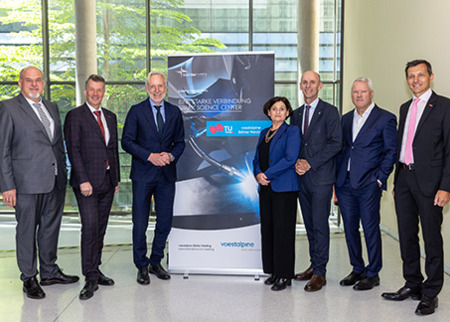
Graz University of Technology (TU Graz) and voestalpine Böhler Welding, a company of the voestalpine Metal Engineering Division, are deepening their long-standing collaboration with a forward-looking research project: under the title ‘Spark Science Center’, they are jointly developing AI-supported solutions to optimize the welding process.

The new cooperation with the Institute of Materials Science, Joining and Forming was officially presented during a professional event. Existing partnerships, such as those with the Institutes for Railway Engineering and Transport Economy and Railway Infrastructure Design, are now being expanded to include another innovative area. 

A good welding result depends on the optimal current-voltage characteristic of the welding device. Determining this optimum involves various input variables. At the heart of the project is the development of intelligent systems capable of automatically analyzing input variables such as base materials, filler materials, shielding gases, or welding methods, and adjusting the welding parameters in real time. The goal is to replace previously manual corrections with machine learning-based automation – ensuring consistently high quality and maximum process reliability.


    Successful partnership

    Research partnerships like this are a key component of our solution expertise as a technology and steel group. With this new project, we are laying the foundation to offer our customers even more precise welding results with reduced processing time.

    Dr. Franz Kainersdorfer, Member of the Management Board of voestalpine AG and Head of the Metal Engineering Division

    We are pleased to further expand our successful partnership with the voestalpine Group through this collaboration in welding technology. The machine learning expertise of TU Graz combined with the production know-how of the Metal Engineering Division creates an innovation boost that strengthens industrial production.

    Univ.-Prof. Dr. Horst Bischof, Rector TU Graz

    In principle, we are creating a vast data space in which all welding results are represented as a function of various input parameters. The machine learning model analyzes them, identifies dependencies, and ultimately provides a recommendation for the given welding task.

    Univ.-Prof. DI Dr. Christof Sommitsch, Head of the Institute of Materials Science, Joining and Forming Technology at Graz University of Technology

    Spark Science Center: Data generation on a large scale

    To obtain the real-world data needed to train the machine learning model, the basic welding lab at TU Graz is being further developed, and at voestalpine Böhler Welding in Kapfenberg, large-scale data will be generated on a dedicated technological test line based on the preliminary work done in the lab.

    The project is planned to run for approximately eight years. The initial research steps are already being carried out as part of a doctoral dissertation.

    How can we help you?

    If you have any questions or feedback, please feel free to contact us. We will be happy to help you!

    Contact us