Automotive Driveshaft Materials
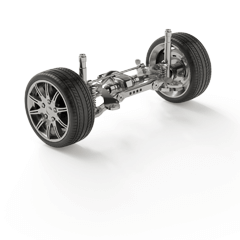
Motorsport driveshafts operate under extreme conditions and are exposed to issues like violent torque spikes, rapid load reversals, and aggressive suspension dynamics, all of which introduce highly specific and demanding failure modes. Driveshaft failures typically result from one or more of the following mechanisms:
1. Torsional stress
2. Fatigue cracking
3. Excess impact/shock
Using advanced alloys, controlled heat treatments, and tight tolerances ensures durability under extreme loads. Combined with regular inspections, these measures help detect early wear and maintain reliability throughout demanding race conditions.
Most Common Causes of Material Related Failure
1. Torsional (twisting) stress
- Torsional overload occurs when sudden torque spikes exceed the material’s shear strength, leading to twisting deformation or fracture, especially in lightweight or under-engineered shafts.
- Cyclic torsional fatigue develops over time as repeated twisting stresses initiate microcracks, which gradually propagate and result in catastrophic failure under race conditions.
High torsional strength: driveshaft failures often result from sudden torque spikes and cyclic twisting loads.
Our high-performance steels such as, BÖHLER W460, are engineered to deliver exceptional torsional strength and core toughness. These properties allow the material to absorb extreme torque loads without cracking or distortion, making it ideal for high-stress motorsport applications.
2. Fatigue cracking
- Is developed from repeated stress cycles, where microscopic cracks initiate at stress concentrators such as surface imperfections or internal inclusions, eventually leading to fracture.
- High-cycle fatigue is especially critical in motorsport, as driveshafts endure constant torsional and bending loads that gradually weaken the material over time—even if peak stresses remain below the yield strength.
Fatigue cracking: often initiated at internal inclusions or overly brittle microstructures under cyclic stress.
Böhler high-performance steels are refined through:
VAR (Vacuum Arc Remelting)
This process enhances material purity and consistency. Steels like BÖHLER W460, with a controlled hardness range of 48–57 HRC, offer the ideal balance of strength and ductility—minimizing crack initiation and extending driveshaft fatigue life in racing environments.
2. Excess impact/shock
- Sudden impact loads, such as from aggressive gear changes or curb strikes, can exceed the driveshaft’s toughness, leading to cracking or complete fracture, especially in materials with low ductility.
- Shock-induced stress concentrations often occur at geometric transitions or surface flaws, where abrupt force inputs cause localized failure under high-speed racing conditions.
Excess impact/shock: sudden force inputs can cause brittle fracture or localized failure in low-toughness materials.
Our high-performance steels such as, BÖHLER W460, are engineered to deliver a balanced combination of high strength and high toughness. This allows driveshafts to absorb unexpected impacts and dynamic loads without cracking—ensuring durability and reliability in aggressive racing environments.
To learn more download our OnePager: