
Additive Manufacturing
Die Casting
Reading time: 12 minutes
Optimizing Die Casting with Spray Process and Conformal Temperature Control

How to Optimize Thermal Management, Cycle Time and Component Quality
In die casting, thermal management determines not only the temperature distribution in the tool, but also process stability, surface quality, scrap rates, cycle time and tool life. At this interface, two closely linked levers interact: the spray process and conformal temperature control.
Today, a significant share of optimization potential lies in the periphery of the casting process, particularly in temperature control and spraying.
While spraying was previously used for cooling and creating a defined release layer, its role in modern processes is shifting to precise, reproducible release agent application. This shift requires a thermally stable die. Only then can spraying be reduced to its actual purpose: creating a defined release layer with minimal resource input.
The Role of the Spray Process in Thermal Management
The spray process is not an isolated secondary step, but a functional part of the overall thermal balance. The key question is efficiency: how to achieve the desired result using as little water, compressed air, release agent and time as possible.
The main objectives are:
- reduced cycle time
- lower media consumption
- longer tool life
- higher availability
- improved component quality and reduced scrap
Technically, the focus is shifting from surface cooling to micro-dosing. Modern release agents enable reliable demolding even with very small quantities—provided they are applied precisely and consistently.
Micro-spraying achieves this by atomizing the release agent and applying it in controlled pulses. The result is a defined release film without unnecessary excess.
From a thermal perspective, excessive spraying destabilizes the process. Reducing the cooling effect lowers energy demand, as less heat needs to be reintroduced into the die. At the same time, fine, demand-based application reduces thermal shock and therefore crack formation, contributing directly to longer tool life.
Why Conformal Temperature Control Is More Than “Better Cooling”
Conformal temperature control is a key factor in productivity, quality and process stability. Reduced cleaning effort, fewer stoppages, shorter spraying times and lower scrap rates all contribute directly to more efficient production.
Simulation plays a central role. Hotspots and thermally highly stressed areas can be identified early, allowing channel layouts, inlet and outlet positions and flow rates to be optimized. Thermal simulations assess cooling performance, while flow simulations ensure balanced medium distribution.
This makes temperature control predictable rather than reactive.
The objective is not the lowest possible average temperature, but a controlled, homogeneous temperature profile aligned with the load. This reduces hotspots, minimizes adhesion and stabilizes the process window.
Why Conformal Cooling?


Improved quality
- Reduced scrap rate
- Improved quality through effective thermal management

Extended service life
- Reduced thermomechanical stresses
- Real tool steel powders for die casting

Increased productivity
- Reduced cleaning effort leading to few machine stoppages
- Reduced cycle time (spray time)

Sustainability
- Increased production efficiency
- Less spraying (microspraying)
- Shorter production chain and reduced processing volume
Interaction Between the Spray Process and Temperature Control
The main effect lies in the interaction of both systems. Stable die temperatures—achieved through multi-circuit systems, conformal cooling channels and local solutions such as jet cooling—mean that spraying no longer needs to provide primary cooling. Its role shifts to ensuring reliable demolding.
This is the basis for micro-spraying.
In practice:
- optimizing only the spray process shifts the problem
- optimizing only temperature control limits the potential
A system-wide approach is required—from hotspot analysis and channel design to flow balancing and spray strategy.
Impact on Cycle Time, Quality and Energy Efficiency
The economic impact is significant. Potential improvements include:
- 60–80% reduction in energy for temperature control
- 70–80% reduction in compressed air consumption
- elimination of fresh water and wastewater in micro-spraying
In addition, tool life is extended due to reduced thermal shock and mechanical stress.
A practical example from the automotive sector illustrates the effect:
- cycle time reduced from 82 to 77 seconds
- media consumption reduced from 1.8 liters to 5 milliliters per cycle
- scrap rate reduced from 4% to 0.9%
- annual cost savings of approximately €197.000
Quality improvements include more homogeneous surfaces, more uniform microstructures, reduced porosity and fewer blowholes—resulting from stable temperature control and consistent release agent application.
Typical Challenges
Typical challenges in implementation include:
- local overheating
- uneven temperature distribution
- thermal fatigue and heat cracking
- thermomechanical stresses
- dependencies on existing equipment and real process conditions
Thermal Fatigue / Heat Checking
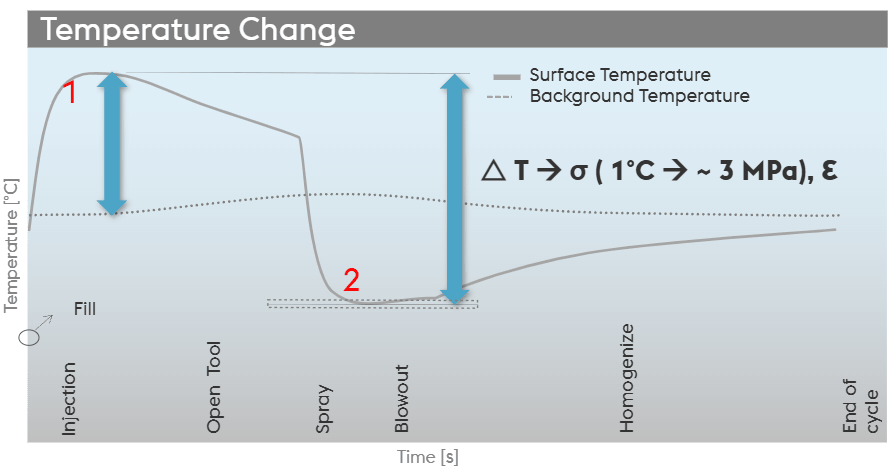
Image source: Dissertation Siller, MCL – Leoben, IMW-MUL, 2003
Solutions
Reliable simulation requires realistic boundary conditions and must consider the full system—tool design, material, casting process and foundry environment.
A structured design loop provides a practical approach:
- Identify hotspots
- Perform thermal and flow simulations
- Evaluate highly stressed areas
- Adjust channel design
- Re-evaluate
This iterative process leads to optimized designs and longer tool life, supported by appropriate material selection.
Optimized Design

Enhanced casting quality and longer mold life through optimized thermal management and stress-optimized channel design.
A System-Level Lever for Process Stability
Efficient thermal management in die casting results from the coordinated interaction of conformal temperature control and a precise spray process.
Conformal cooling stabilizes heat distribution and reduces hotspots, creating the conditions for spraying to function as a controlled release step rather than a cooling measure.
For production and technical teams, the key takeaway is clear:
The greatest optimization potential lies in the overall thermal system, not in isolated measures. Real gains are achieved when channel design, thermal behavior and spray strategy are aligned, supported by simulation and consistent process control.
Contact Our Experts to Find Out More
Ready to find out how to optimize thermal design for your die casting operation? Contact our experts today!