
Oil and Gas
People in Focus
Reading time: 8 minutes
How Additive Manufacturing Is Reshaping Oil & Gas: Insights from Sami Arsan

Over the past decade, additive manufacturing (AM) has moved from niche curiosity to a strategic capability for some of the world’s largest industrial players. In the Oil & Gas industry, companies are increasingly exploring AM to accelerate product development, optimize component design, and reduce manufacturing complexity. Few have played a more significant role in this evolution than Sami Arsan, who has helped shape voestalpine’s global AM business from its earliest days.
I sat down with Sami to discuss AM’s unique value, customer adoption, competitive advantages, and the future of digitally enabled manufacturing in the Oil and Gas industry.
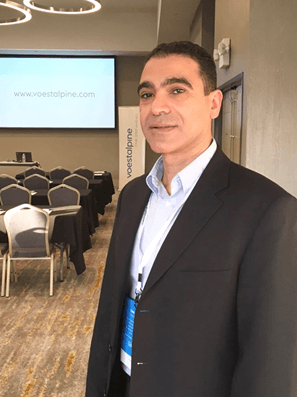
Sami Arsan
Director, Strategy and Business Development
Additive Manufacturing, Oil & Gas, CPI and Renewables
Sami Arsan brings over 25 years of industry experience with leading tooling and equipment supply organizations, with a recent focus on additive manufacturing (AM) applications in the energy sector, as well as roles in global sourcing, advanced and disruptive manufacturing technologies, and component engineering. He was a founding member of the voestalpine Additive Manufacturing Centers in North America. Sami holds a degree in Mechanical Engineering, is a Project Management Professional (PMP), a Professional Engineer (P.Eng.) in the Province of Ontario, Canada, and is Certified in Additive Manufacturing by SME.
From Startup to Scale
Sami, you’ve been a central figure in voestalpine’s AM journey. When did it all begin?
It goes back to 2016. I remember starting with just my personal laptop, preparing our first strategy presentation for senior leadership in Vienna. By early 2017, we were purchasing our first machines. What began with two M290s has grown into eight machines across Houston and Canada. It’s been roughly eight years, and what a journey it’s been.
In your view, what makes AM uniquely valuable compared to traditional manufacturing?
Additive manufacturing is a game changer. It brings enormous design freedom. Complexity is essentially free. If you can design it, you can print it, especially when it comes to internal geometries that traditional machining simply can’t produce without multiple operations.
AM also accelerates innovation. With investment casting, even a small design change means new tooling, new lead times, and new validation cycles. With AM, you change the radius, print overnight, and validate. You focus on development, not waiting.
And there’s part consolidation. Components traditionally made from three, four, or even twenty pieces can be produced as one— lighter weight, better performance, and no welding or assembly requirements.
Do large multinational companies approach AM differently from smaller firms?
Yes, major customers (operators) allocate significant budgets for innovation because being first to market matters. Smaller companies may be more willing to wait and rely on traditional prototyping. Ultimately, it depends on each company’s strategy and priorities.
Educating the Market and Building Trust
How do you help customers understand what AM can and cannot do?
Many customers still need education. Some think AM is about plastics or fancy shapes. We start by showing them metallurgy, standards, and real‑world performance. We conduct lunch & learn sessions as part of our regional roadshows, giving us the opportunity to meet directly with customers, especially engineers and designers, to walk them through the fundamentals of AM and its real‑world applications.
Trust is crucial. We’ve had situations where a customer requested a quote and, after evaluating it, we told them honestly: “This doesn’t make sense for AM.” Their respect for that honesty strengthened the relationship. Some customers later gave us more business because they trusted we would always give transparent guidance, not just chase a purchase order.
Responsiveness is another differentiator. We acknowledge every request within 24–48 hours. Customers know we are there for them.
How does voestalpine’s approach compare to other AM service providers?
The difference is customer centricity. We help customers with design for additive manufacturing (DfAM), guidance, cost optimization, and responsiveness. That support differentiates us significantly. Our one‑stop‑shop concept for additive manufacturing in Oil & Gas includes powder production and qualification design for additive manufacturing (DfAM), simulation and process validation, metal 3D printing, post‑processing and heat treatment, and final machining and inspection. All processes are executed under API 20S AMSL 1, 2, and 3, enabling industrial‑scale serial production of mission‑critical components for oil & gas.
Proven Performance and Quality Assurance
Can you share a case where AM delivered clear competitive advantage?
One example is a family of downhole flow manifolds. Traditionally cast, they required extensive manual work. We redesigned them for AM, delivered a turnkey solution, and achieved zero failures over six years of production.
Have customers raised concerns about AM?
Certainly. Mainly around material integrity and quality. With AM, you are building the material and the component simultaneously. Standards like API 20S give customers confidence. AMSL levels define increasing part criticality, ranging from low risk, non critical components at AMSL 1 to medium risk operational parts at AMSL 2, and ultimately to high risk, safety or pressure critical parts at AMSL 3 that require the highest degree of qualification, testing, and control.
The Future: Scaling, New Segments, and Customer Success
How do you help transition customers from prototype to full production?
We begin with the right questions—performance requirements, expected volumes, regulatory considerations, and cost targets. We collaborate on DfAM from the first iteration so scaling becomes seamless.
As AM matures, what new segments are opening?
Completion tools, critical components BOP (blowout preventor) components, digital inventory, and reverse engineered legacy parts are growing rapidly. Consolidating multi part assemblies into single AM components is also a major value generator.
What does long‑term customer success mean to you personally?
It’s about measurable value: improved performance, reduced cost, and faster innovation. Customer success is mutual growth. When they win, we win.
Ready to find out more?
Sami’s insights highlight how additive manufacturing is reshaping the Oil & Gas industry and how voestalpine is helping customers unlock its full potential. If you’re exploring AM for an Oil & Gas application, you can find out more on our Additive Manufacturing Applications page or contact our team using the button below. We’d be happy to discuss your requirements and how we can support your next project.