Welding Technology
Welding of Rails
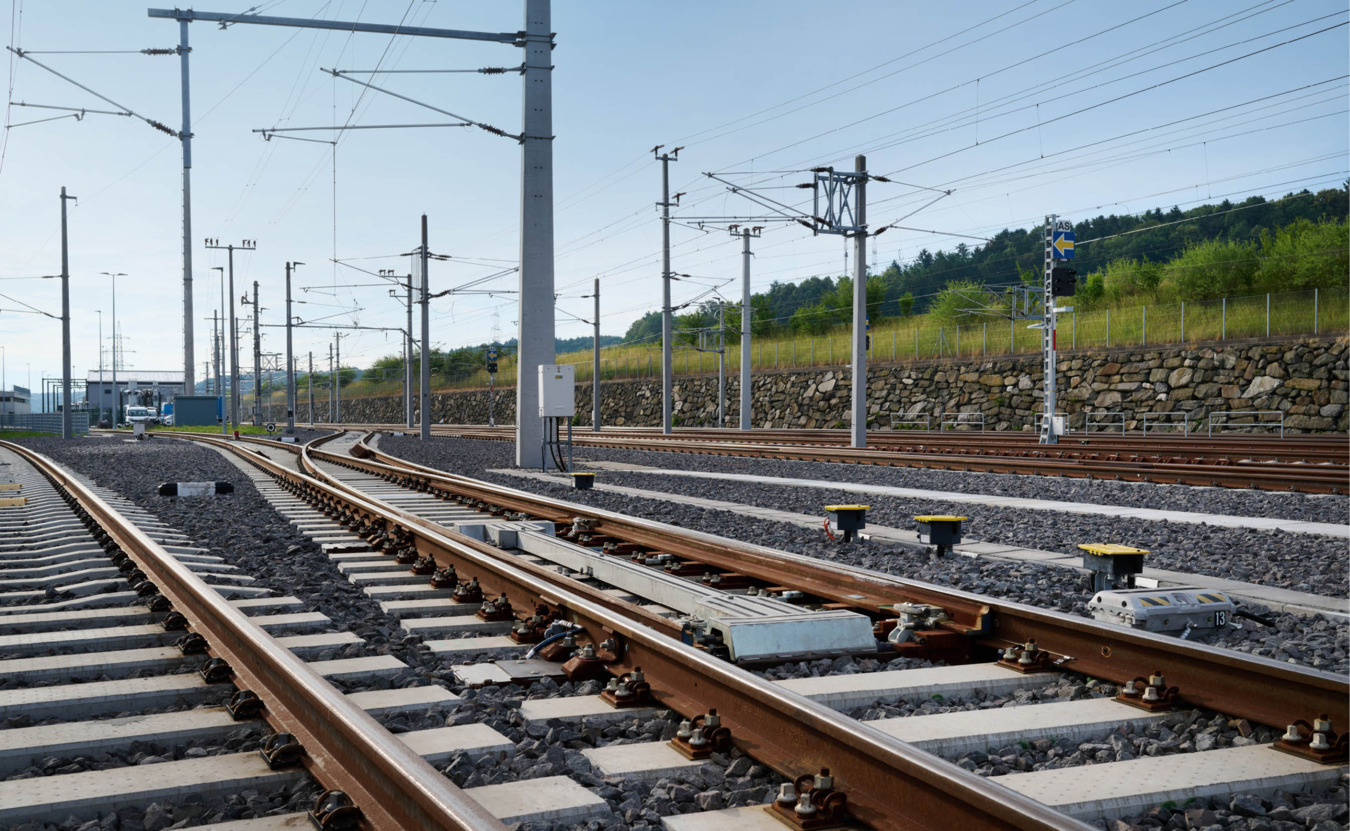
When riding the railroad today it becomes obvious that the "clickety-clack" noise caused by the fish plated rail joints is a thing of the past. The welding of the rails to form a continuous welded track reduces the dynamic forces exerted on the permanent way and the cars.
Without welding technology, the manufacturing of such continuous welded track would be impossible. Currently three welding techniques are employed:
Flash butt welding
Aluminothermic welding
Electric arc welding
This is why rail steels, aside from the demanded materials characteristics, also must have the corresponding weldability. This is determined by the chemical composition of the rail steel. For special questions regarding the welding of head special hardened rails our welding recommendations are available, which can be downloaded here.
This is why voestalpine Schienen pays close attention to welding characteristics during the development of new rail steels. Newly developed rail steel would be completely useless to the railroads if the continuous welded track could not be produced using standard welding techniques. This is why we conduct welding experiments early on during our R & D projects.
Since the welding of rails is not part of our services, we enter into partnership with specialists in the field.
In the case of Bainitic rails, the method for aluminothermic welding was optimized jointly with Goldschmidt-Thermit and the flash butt welding method together with VAE AG. Submerged arc welding, in particular as part of a contract on HSH-M grooved rails was guaranteed together with Elektro-Thermit Dienstleistungs-GmbH.
Welding Techniques
The following welding techniques are currently employed in Europe:
Stationary flash butt welding:
The rail ends are clamped in the welding machinery, positioned, butted up against each other and electric current of several thousand amperes is sent across the areas of contact. The two ends are heated to white heat and the rails are welded by a rapid stroke.
In this manner, welding shops are able to produce rail strings of up to 800 m in length, that are then delivered to a construction site.
Mobile flash butt welding:
This method has been used at construction sites since the beginning of the seventies. Vehicles on rails or two-way vehicles are used. In conjunction with just-in-time delivery (see menu item "Logistics/Services") of ultra-long rails, this track can be produced rapidly and economically in cases where more than 40 welds per piece are required. Another advantage is the metallurgical quality of the welding, since no additional materials are introduced.
Aluminothermic welding:
The rail strings produced in the welding shop or using the mobile machinery are welded to form a continuous welded track at the construction site, using a method established over 80 years ago. First, a casting form is fixed around both rail ends. In a crucible, the chemical reaction of iron oxide and aluminum powder yields fusible thermite steel that is poured into the casting form, welding the rails together. Different alloying elements are added to the thermite portion that make the characteristics of the butt comply with modern qualitative demands. The advantage of the method is in its high flexibility, since the needed equipment can be quickly transported from site to site.
Electric arc welding:
It is used to weld rails and also for deposit repair welding. The main application is in light rail transit where special attention has to be paid to the possibility of re-profiling grooved rails through welding technology. The worn areas of running surface and head are filled in with submerged arc welding and then the rail head is ground to a new profile or a different appropriate shape.
Another method, not yet established in Europe is gas pressure welding, which has been employed successfully for years in Japan and other far eastern countries in the place of mobile flash butt welding. The difference to flash butt welding is that the rail ends are heated using a gas burner. The necessary equipment is much smaller and much more flexible than mobile flash butt welding machines. However, the method is not as simple as aluminothermic welding.
What We Offer
Vignole Rails
Grooved Rails
Head-hardened Rails
Rails-Services