Life-Cycle-Costs

Life-Cycle-Cost of the Track

The operators of rail traffic increasingly use concepts such as Life-Cycle-Costs, Total Cost of Ownership or Total Cost Considerations. Purchasing no longer tries to determine the cheapest product, but the most benificial product in the long term.

European standards and customer specific specifications determine the qualitative demands of the product. voestalpine Schienen GmbH offers highest quality products to the customer, their characteristics exceed the demands.

Additional services offered are just-in-time deliveries to construction sites and comprehensive technical consulting on the selection of materials.

The goal is to recommend that product for the individual application, which will incur the lowest total cost over the entire life cycle of the product. Several analyses in Europe and overseas have shown that the utilization of high quality and so naturally more expensive products have led to lower maintenance costs in all cases.

Since most of these studies make clear qualitative statements but rarely also offer a quantification of savings, voestalpine Schienen has already since 1997 thoroughly investigated the issue of life cycle costs for track.

Case dependent results were evaluated for the use of fine-pearlitic head special hardened grooved rails in light rail public transport companies. Together with partners,  we have jointly developed the two software programs LCC-Tool and LCC-Rail, which can be used to calculate Life-Cycle-Costs case dependent. This enables the customer to decide on material selection appropriate to his particular conditions.

voestalpine´s LCC-Tool for Grooved Rails

voestalpine Schienen GmbH produces fine pearlitic head hardened grooved HSH® rails for trams – or streetcars – since 1992. These rail grades have a higher wear resistance as compared to the usually used grade 700. The longer service life improves customer’s value added. This advantage was proofed in cooperation with five major tramway operations (see the project “Life-Cycle-Costs of Grooved Rails”).

The results showed that using head hardened grooved HSH® rails produces a significant cost advantage compared to normal grooved rail steels.

As a consequence of this study, a software program was developed which allows to chose the optimum rail steel grade for the actual operation conditions. The target is to increase service life and minimize the annual costs of the infrastructure.

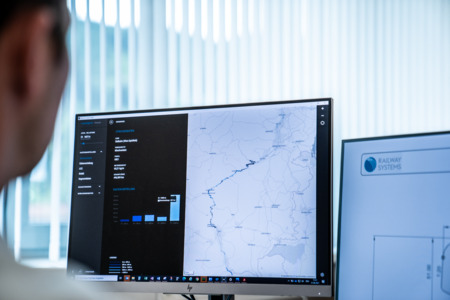
To calculate the life-cycle-costs with the LCC-tool, data of the curve geometry and the actual load of the track are needed. Results are presented preferentially by charts but can also be listed in Tables. Examples for these charts are shown in the Attachment. The program operates in real-time and allows flexible changes of parameters.

This allows to do the calculations in a dialog with the customer. In the same way, sensitivity analyses of the most important cost drivers can be done simple and quick.

If you have questions on this LCC-tool, or if you like to see it, please do not hesitate to contact the Technical Customer Service.

Life-Cycle-Costs of Grooved Rails

Since 1992, voestalpine Schienen GmbH has produced fine-pearlitic head special hardened HSH® grooved rails for tramway systems. These rail steels exhibit a higher resistance to wear than those usually used in rails of grade 700. They offer higher benefit to the customer due to a longer useful life span. The improved characteristics of the materials also lead to an expectation of lower maintenance expenses and related cost savings.

To prove this assumption, the company DIE INGENIEURWERKSTATT GmbH was contracted to provide an analysis of life cycle costs, that is the entire costs from the acquisition to the disposal. This work was done together with five well-known light rail public transport companies in Germany and Austria.

The findings proved, after two years of research, that the utilization of head special hardened HSH® grooved rails in curves leads to a significant cost advantage over the use of rails hardened in the traditional manner. The prognosis for the useful life span of a head special hardened rail is up to 4 times that of a traditionally hardened rail. Cost savings of up to 15% of total costs per year are achieved, with maintenance costs that are up to 40% lower.